
Optimal sales territories in minutes, not weeks.
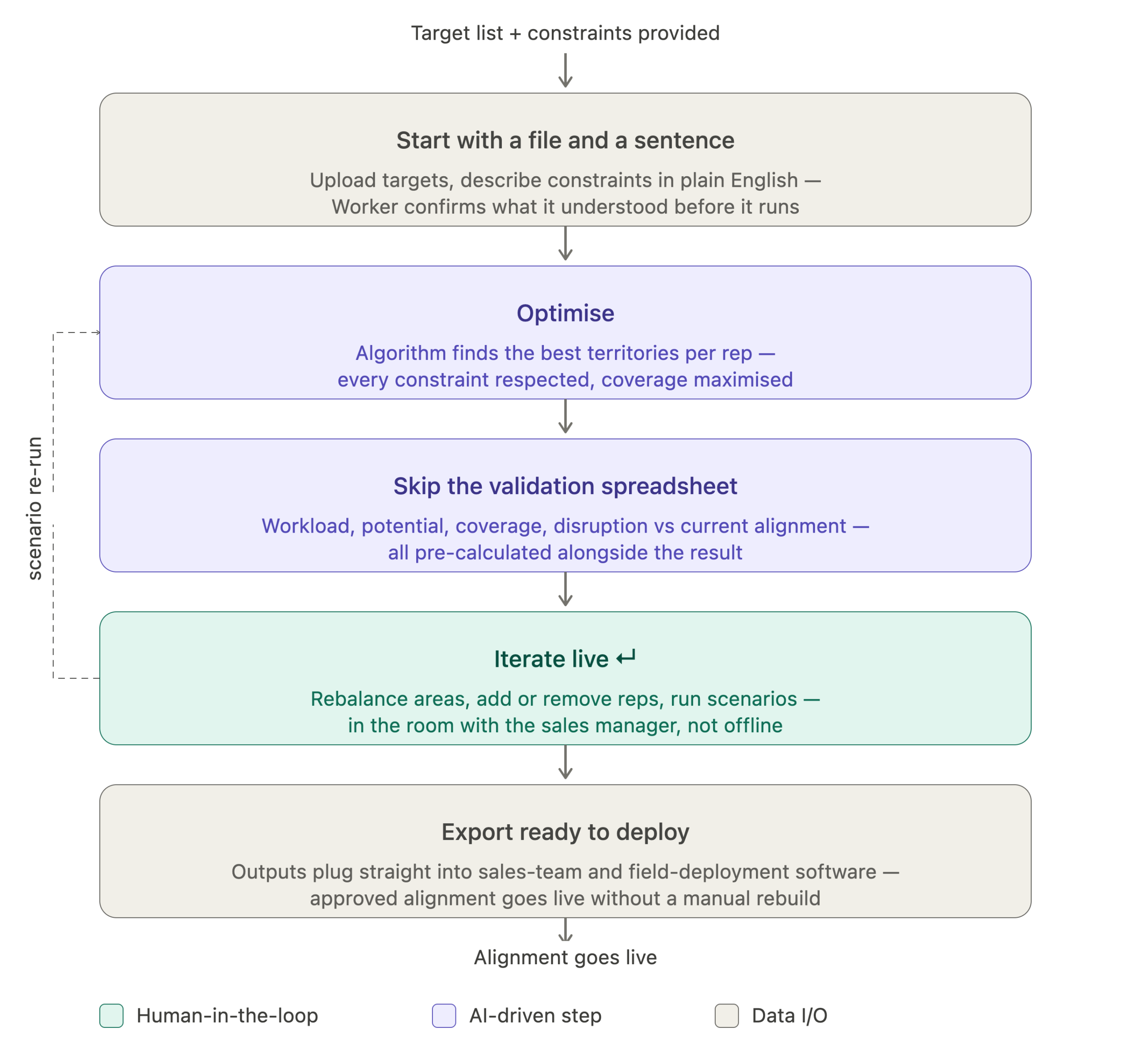
The Sales Territory Digital Worker runs the entire territory-alignment process end to end - from cleaning the target data, through constraint-aware optimisation, to an export ready for your field-deployment tools.
You describe the business rules in plain English; it returns a balanced, optimised alignment ready to share with the sales manager.
In Production:
Live in production with Syneos Health - Sales territory design and planning is one of the named capabilities of the deployment.
Territory alignment is slow, manual and hard to iterate
Results are suboptimal because they are built by hand
Analysts assemble territories manually in tools such as Veeva Align / Territory Designer or AlignStar, trying to balance many factors at once - workload, market potential, drive time, account coverage. It is an error-prone process that does not scale well as the number of constraints or territories grows, and the result is rarely the genuinely optimal balance.
The process is too slow to repeat
Because territories are built by hand, re-optimising regularly eats up analyst time or expensive contractor hours every cycle. Teams that would benefit from rebalancing monthly simply can’t afford to, so alignments drift out of date and field productivity leaks away.
Iteration during review is painful
When a stakeholder wants to adjust a region on the map, the change can’t be explored live. Requests are collected, taken offline, re-run, and brought back - a multi-day loop for what should be a two-minute what-if. Momentum and buy-in are lost in the handoffs.
What Does This Digital Worker Do?
Optimise, don’t balance by hand
Upload the target list, describe the constraints in natural language, and the Worker returns an optimised alignment in minutes - with all the comparison metrics pre-calculated, so you skip the spreadsheet stage entirely. Exports come preconfigured for your existing field-management software.
Automates the entire process
A bespoke optimisation algorithm produces alignments that respect every business constraint and, in benchmarking, consistently outperform manual alignments - in a fraction of the time.
Live iteration
Rebalance specific areas, add or remove territories, and run exploratory “where should we add a rep?” scenarios in the room, instead of collecting feedback and re-running offline.
Describe the rules in plain English. Get an optimal, exportable alignment.
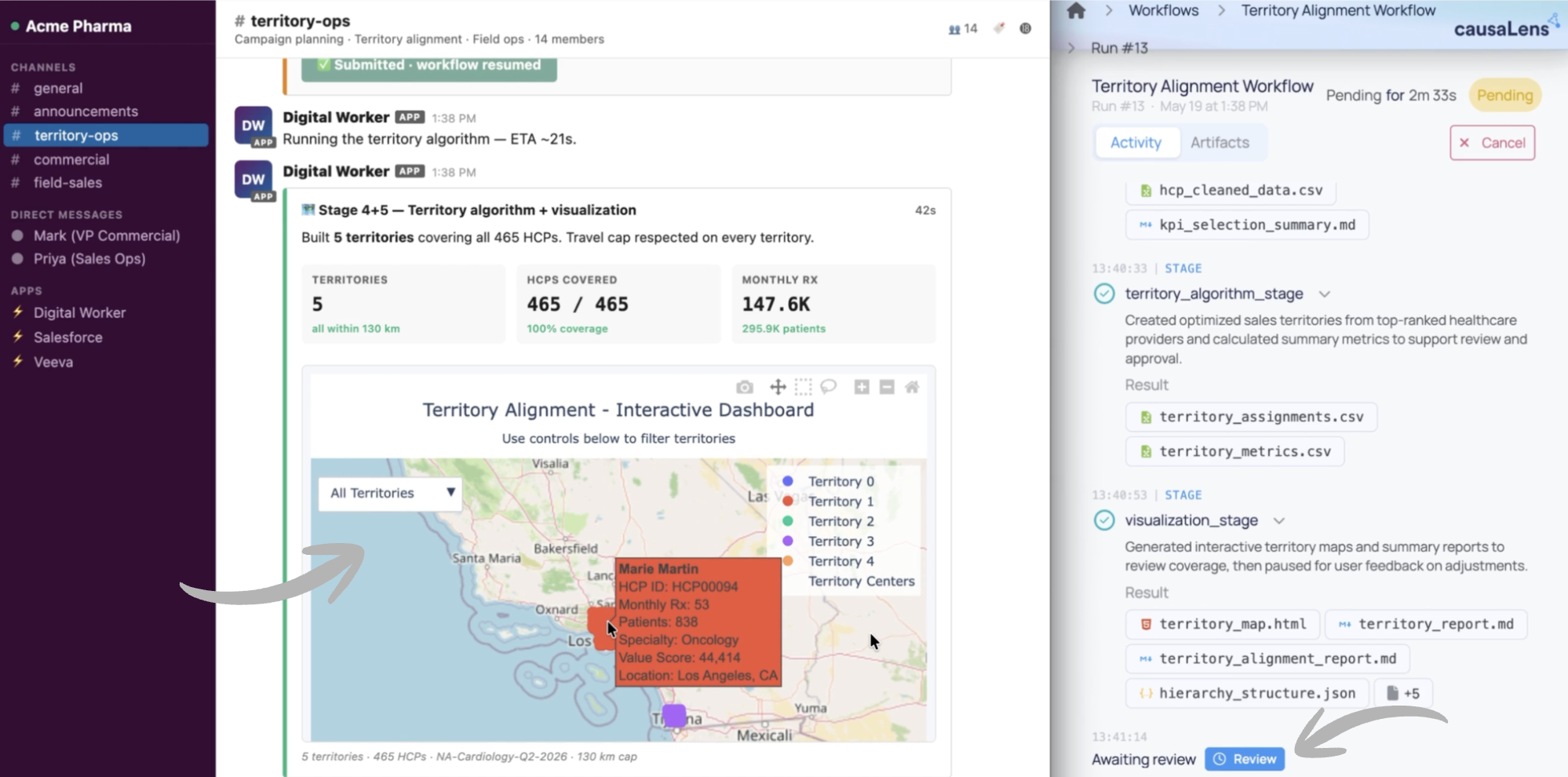
- The Sales Territory Digital Worker handles the full process end to end and is built for commercial operations teams, not engineers.
- It cleans the data, optimises against your constraints, and produces an export ready for downstream deployment - with a human review built in at the points that matter.
Plug into Existing Stacks
Illustrative Coverage:
- Target and account lists (the file you start from)
- HCP / HCO master data and account attributes
- Geographic units - ZIP / brick / postal geography
- Market potential and prescribing data per account
- Rep roster, capacity and alignment
- Constraint inputs - workload, drive time, continuity rules (described in natural language)
- Field-deployment and territory-management tools for export.
Built for the teams that own field deployment:
Alignments and re-alignments across the field force
Workload, potential, coverage against business rules
Territory plan sign-off and headcount what-ifs
New structures stood up fast for any launch or expansion
Client alignments at scale - no contractor hours burned
Typical timeline: an MVP in two to three weeks against a small, high-value scope, followed by a production deployment scoped to your data, security and integration requirements. A dedicated causaLens AI engineer builds and runs the Worker; a causaLens value engineer owns project success.
Sales operations, commercial analytics and field-force effectiveness teams, sales leadership running sign-off and headcount what-ifs, and launch teams standing up new structures. No engineering or data-science background required.
Built on the core capabilities of the causaLens Digital Worker platform
The Sales Territory Digital Worker is a multi-agent system, governed end-to-end by the capabilities that underpin every causaLens Digital Worker. These are what make the difference between a mapping tool and a production-grade automation.
The Multi-Agent Workflow:
A bespoke optimisation algorithm sits at the core of the alignment. It finds the best possible territories for each rep - maximising coverage of the target base subject to your constraints. Benchmarking shows it consistently outperforms human operatives in the majority of cases, and does so in a fraction of the time. This is the same proprietary optimisation heritage causaLens brings from its AutoML and causal-AI origins, applied here to a classic combinatorial alignment problem.
Integrations:
- Target files and account data sources
- Field-deployment and territory-management tools for export, integrated via the Agentic Data Mesh
- Your approved large language model - we are model-agnostic and bring-your-own-LLM
- Deployment on causaLens cloud, your private cloud, or fully on-premise
What It Replaces & Reduces:
- 100s of analyst hours per alignment of manual map-building and rebalancing
- Spreadsheet-based validation of workload, potential and coverage metrics
- Offline, multi-day iteration loops between analyst and sales manager
- Expensive contractor cycles for routine re-alignments
Common questions, answered
In plain English. You upload the target file and describe the constraints - number of territories, workload balance, market-potential targets, drive-time limits, account-continuity rules. The Worker extracts them and shows you what it understood before it runs.
In benchmarking, the bespoke optimisation algorithm consistently outperforms manual alignment in the majority of cases, and produces the result in a fraction of the time. Crucially, it respects every constraint you set, which is where manual balancing tends to break down as the number of constraints grows.
Yes. Outputs come preconfigured and plug into existing sales-team management and field-deployment software, including tools such as Veeva Align and AlignStar, as well as Excel.
Yes. We deploy on causaLens cloud, your private cloud, or fully on-premise. The Worker is model-agnostic - use our default model, or bring your own approved LLM. Your data never leaves your environment unless you choose otherwise.
Our internal benchmarks show precision and accuracy over 90% on known examples. On our reference pre-launch workflow (the Syneos DALi project), precision, accuracy and recall were all under 20% before the Reliability Framework was applied; with the in-loop and out-of-loop validation that gates this Worker, all three are north of 80%, with precision and accuracy over 90%. The benchmark suite runs against every release and the methodology is shared during deployment.
Typical timeline: an MVP in two to three weeks against a small, high-value scope, followed by a production deployment scoped to your data, security and integration requirements. A dedicated causaLens AI engineer builds and runs the Worker; a causaLens value engineer owns project success.
Sales operations, commercial analytics and field-force effectiveness teams, sales leadership running sign-off and headcount what-ifs, and launch teams standing up new structures. No engineering or data-science background required.
Production-grade, Not Prototype
Versus manual alignment
Days of analyst and contractor time become minutes. The result is genuinely optimised against your constraints rather than balanced by hand, and every comparison metric is pre-calculated so review starts from an answer, not a spreadsheet.
Versus standalone mapping tools
Tools such as Veeva Align / Territory Designer and AlignStar give you a canvas to draw and balance territories manually. This Worker runs the optimisation for you, accepts the constraints in natural language, and lets you iterate live - then exports straight back into those same deployment tools.
Versus generic LLM tools
A generic model cannot be trusted to manipulate the structured data behind an alignment without dropping or inventing values. This Worker keeps the data in auditable tools, validates the result against your constraints, and gates the output with the Reliability Framework.
The Reliability Framework
In-loop judges, constraint validation, provenance tracking and benchmark-first development. This is the layer that turns a long-running agent into a production-grade automation - trusted by commercial operations, and defensible when leadership challenges the plan.