
Every invoice. Duplicates and fraud flagged before payment. Variances investigated autonomously, resolved on your approval.
The Procurement to Pay Digital Worker reads the whole invoice backlog. It flags duplicates and fraudulent billing before payment, matches every invoice against the work order, hunts down the change order that explains the variance, and comes back with a resolution for your reviewer to approve. On approval it registers the approved change order against the work order and posts back to the ERP.
Customers automating their workflows













The Current Issue With Invoice Processing?
Duplicates and fraudulent billing
- Duplicate payments average 0.2% of supplier spend — at least $2 million for every $1 billion processed — even in organisations running automated AP controls (Xelix, 1.2m invoices across 187 ERP systems). At pharma scale, that is a material number.
- Deliberate billing schemes work the same way: they exploit the fact that at real volumes, nobody re-reads the invoice against the contract, the prior submissions and the vendor's own correspondence. The leakage is usually found by a recovery audit a year later, if at all.
Too many systems & spreadsheets
- A mismatch between the invoice and the work order has to be investigated by hand: the ERP for the work order, the vendor's mailbox for the change order, the clinical or operational system to confirm it was registered, then back to the ERP to correct it.
- In life sciences this is compounded by CRO change orders, protocol amendments and pass-through costs that arrive out of sequence and out of system.
Unsettled spend distorts the P&L
- Until the invoice is settled, the spend cannot be recognised or cleared. It sits in the backlog and shows up as noise in the general ledger and the P&L.
- The CFO does not get a true picture of what the business is actually committed to, and the days-to-settle number is one no finance leader is comfortable defending.
What Does This Digital Worker Do:
Flags duplicates and billing anomalies before the money leaves
- Every invoice is read against prior submissions, the contract, the work order and the vendor's own correspondence - not sampled, and not matched on invoice number alone, which is how near-duplicates slip through ERP controls.
- Suspected duplicates, out-of-contract pricing and billing that does not reconcile to any authorised work order or change order are surfaced to a human before payment, with the evidence attached. Prevention at the point of processing, not recovery twelve months later.
Investigates variances, does not just flag them
- The Worker identifies the variance - an invoice at $487,000 against a work order of $412,000 - and then goes and finds the reason: the change order notification sitting in the vendor's email thread, and the confirmation that it was registered in the operational system.
- The reviewer receives the variance, the evidence and a recommendation together, not a queue of unexplained mismatches.
Resolves end to end, into the ERP
- On approval the Worker registers the approved change order against the work order and posts the resolution back to the main ERP - no re-keying, no second ticket.
- Rolled across the whole backlog, days-to-settle falls, spend clears when it should, and the CFO gets a clean, current view of committed spend.
blank space
Demo of the Digital Worker:
Select the invoices. The Digital Worker runs the rest.
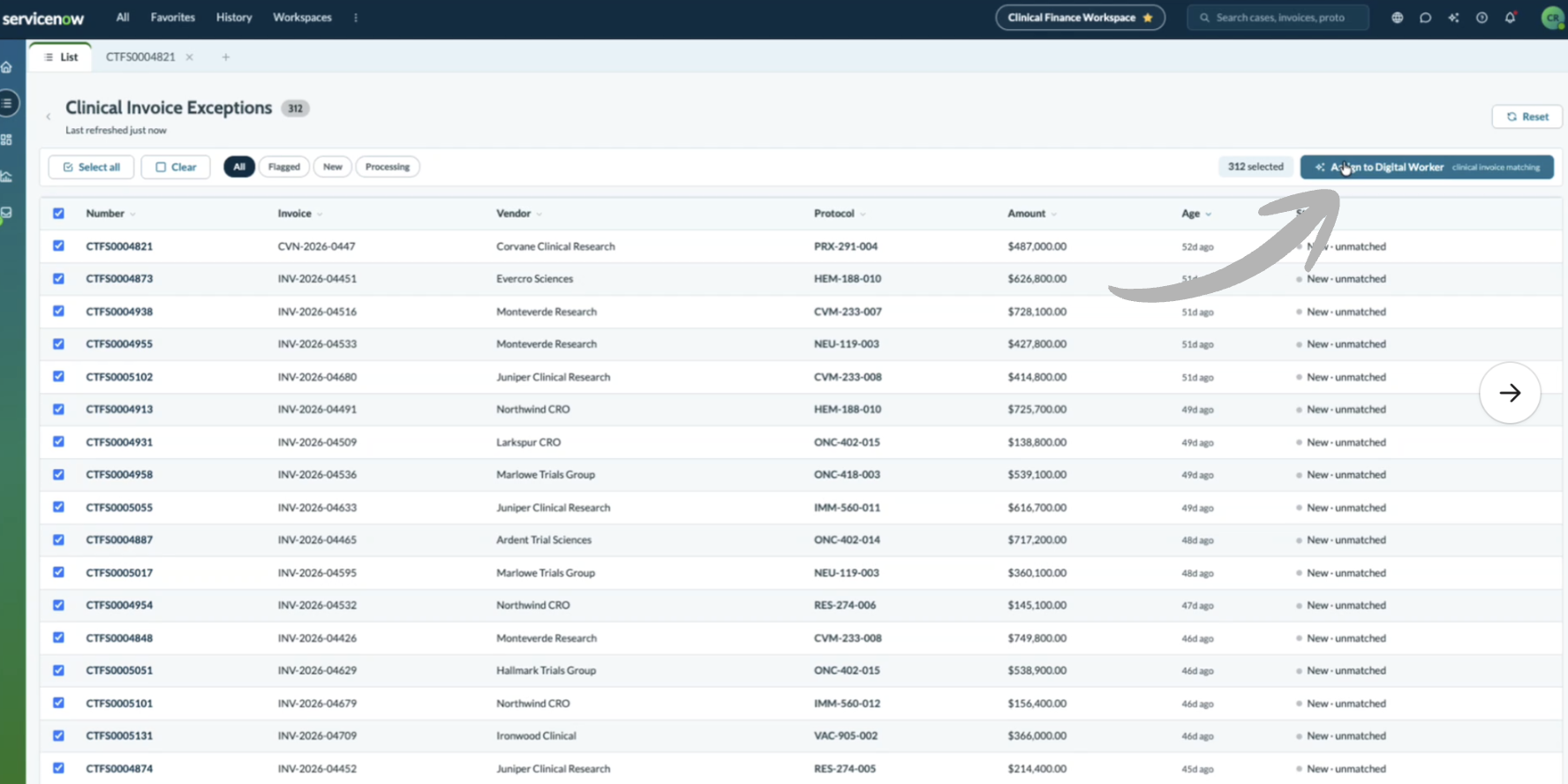
- The team hands the Worker a selection of invoices from the backlog, the way they would hand them to a colleague.
- It runs the end-to-end workflow: duplicate and integrity checks, match, investigate the variance, gather the evidence, recommend, and - once approved - correct and post.
Built for the teams that own the spend
- Accounts payable and P2P operations - working exception queues at volume, invoice by invoice.
- Finance shared services and GBS - running AP across business units or clients, where cost and control both sit with the same team.
- Controllers and financial close teams - who need unsettled spend cleared before it distorts the ledger.
- Internal audit and financial controls - who want duplicates and billing anomalies caught at processing rather than surfaced by a recovery audit.
- Life sciences finance and clinical finance - reconciling CRO and vendor invoices against work orders, change orders and protocol amendments.
Built on the core capabilities of the causaLens Digital Worker Factory
The P2P Digital Worker is a multi-agent system, governed end-to-end by the capabilities that underpin every causaLens Digital Worker - the difference between a brittle bot and an automation you can trust to hold back a suspect invoice and post a correction to the ERP.
Core Architecture:
The capability that separates causaLens Digital Workers from copilots and RPA. A human-in-the-loop gate sits on every variance and every suspected duplicate: the Worker pauses, presents the finding, the evidence and the recommendation, and only the approved resolution is executed. In-loop LLM judges act as quality gates on the investigation, verifying that findings are grounded in the actual invoice, work order and change order rather than inferred. The self-healing loop keeps the automation working when an underlying system changes.
Integrations:
- Your ERP, procurement and requisition systems, contract repository, Outlook / email and operational systems such as Veeva
- Your existing approval flows, reused rather than replaced
- Your approved large language model - we are model-agnostic and bring-your-own-LLM
- Deployment on causaLens cloud, your private cloud, or fully on-premise
What It Replaces & Reduces:
- Duplicate and fraudulent billing that clears at volume and is recovered, at best, by an audit a year later
- Manual investigation of every invoice variance across four or more systems
- Days of settlement delay that keep spend from clearing the ledger
- Brittle RPA bots that match invoices but cannot investigate why they do not match
- Re-keying corrections between the work order, the requisition system and the ERP
Common questions, answered
Out of the box: your ERP, Outlook / email, the requisition system, the contract repository and operational systems such as Veeva. Because it works through the Agentic Data Mesh, the workflow plugs into your existing P2P stack rather than being tied to these specific tools.
ERP controls generally match on invoice number and exact amount, which is why near-duplicates get through: a resubmission with a different reference, a re-invoiced line after a system migration, the same work split across two invoices. The Worker reads the invoice against payment history, the contract and the work order, so it catches the ones that are duplicates in substance rather than in string.
Your reviewer approves the resolution before the change order is registered or anything is posted to the ERP - each action with a full audit trail.
Existing tooling does three-way matching well and then hands you an exception queue. It cannot go and read the vendor's change order email, confirm the change was registered operationally, and correct the work order. This Worker resolves the exception rather than routing it, and its self-healing loop adapts when an underlying system changes instead of breaking.
They stay with the human. The Worker resolves what it can evidence and escalates what it cannot, with everything it checked attached - so the reviewer starts from a complete investigation rather than a blank mismatch.
Reliability is the core of the Digital Worker Factory: a human gate on every variance and every suspected duplicate, in-loop LLM judges verifying findings are grounded in the source documents, structured fields handled through traceable tools, and full provenance. We benchmark duplicate detection recall and false positive rate on your own invoice history during deployment, and report against them. Methodology available on request.
Yes. We deploy on causaLens cloud, your private cloud, or fully on-premise / air-gapped. The Worker is model-agnostic - use our default model or bring your own approved LLM. Your data never leaves your environment unless you choose otherwise.
Production-grade, not prototype
Versus the manual exception queue
The cost and the control risk both sit in the exceptions. The Worker checks every invoice for duplicates and billing integrity, investigates variances across the ERP, the vendor mailbox and the operational system, and resolves on approval - so leakage is caught before payment and spend clears.
Versus recovery audits
A recovery audit finds the duplicate after the cash has gone, then charges a share of what it claws back. This Worker reads every invoice before payment, so the finding happens at processing rather than in a retrospective review twelve months later.
Versus RPA
Rule-based bots match fields and break the moment a screen changes. They cannot reason about why an invoice does not match the work order, or spot a duplicate that carries a different reference number. This Worker investigates, and its self-healing loop adapts to system changes rather than needing a team to keep it alive.
The Reliability Framework
A human gate on every finding, in-loop judges verifying against the source documents, the self-healing loop and full provenance. This is the layer that lets a long-running agent hold back a suspect invoice and post a correction to your ERP - and stand up to audit.