
Every AR exception investigated, explained and resolved - automatically.
It reads the exception, pulls the invoice and payment detail from the ERP, finds the commercial term in Salesforce that explains the gap, and returns a recommended resolution for a human to approve - then posts the settlement back and logs the term so the same case never needs a human again.
Customers automating their workflows













Cash is trapped in a queue of exceptions nobody can clear
Every exception is a manual investigation
- Hundreds, sometimes thousands, of AR exceptions sit open in ServiceNow at any one time.
- Each one is worked by hand: open the ticket, find the invoice in the ERP, check what was actually received, then go hunting in Salesforce for the contract term that might explain the difference. One discrepancy, three systems, no shortcut.
DSO stays stuck and the GL stays wrong
- While an exception is open, the cash stays unapplied and the receivable stays on the books.
- Days Sales Outstanding sits above 45 days, the general ledger carries balances that were never really outstanding, and the working capital tied up in the backlog is capital the business cannot spend.
Repeat monthly discrepancies
- A volume rebate, an early-payment discount, a freight term - the reviewer works it out once, resolves the ticket, and writes nothing back to the system of record.
- Next month the same customer short-pays for the same contractual reason and a human starts the investigation from scratch. The knowledge leaves with the ticket.
What Does This Digital Worker Do?
Investigation, on autopilot
Allocate the exceptions and trigger the workflow. The Worker runs a multi-step agentic process across ServiceNow, the ERP and Salesforce, extracts the invoice total, the amount received and the shortfall, and returns a recommended resolution with the cause explained - not a flag, an answer.
The cause, traced to the contract
It pulls the invoice total and received amount from the general ledger in the ERP, then navigates to the specific contract in Salesforce and identifies the commercial term behind the gap - a 3% volume rebate, an agreed discount, a disputed line. Every figure is traceable back to the record it came from.
Resolution, written back end to end
On approval the Worker completes the downstream steps itself: it logs the term against the contract in Salesforce so the same case is handled automatically next time, and posts the settlement back to the general ledger in the ERP, releasing the full amount into working capital. Every step is captured in an audit trail.
blank space
Demo of the Digital Worker:
One reviewer, one screen, one decision per exception - the investigation is already done
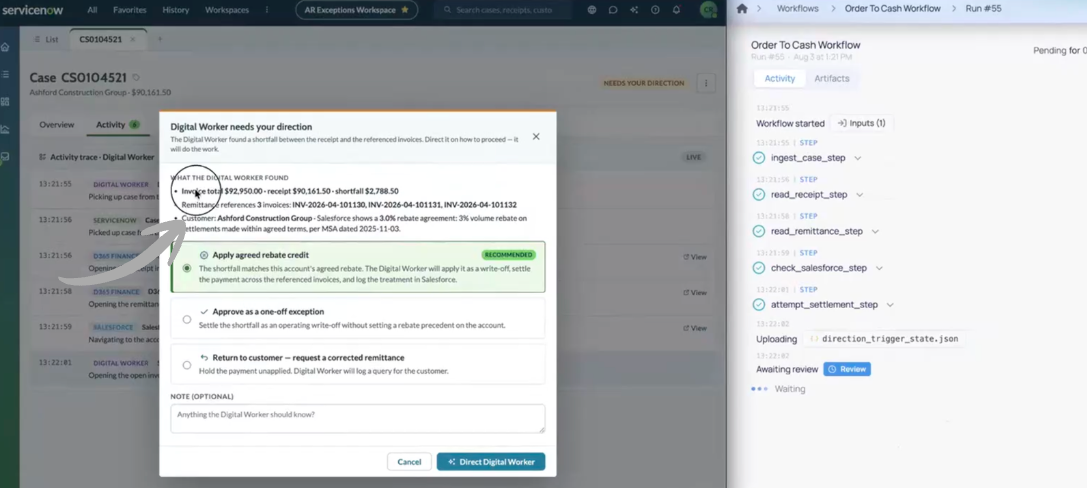
- Built for the AR and Order-to-Cash team, not for engineers.
- It sits across your service desk, your ERP and your CRM, investigates every exception end to end, and presents a recommended resolution with its evidence - with a human approving before anything is posted.
Built on the core capabilities of the causaLens Digital Worker platform
The Order-To-Cash Digital Worker is a multi-agent system, governed end-to-end by the capabilities that underpin every causaLens Digital Worker. These are what make the difference between a script that drafts a suggestion and a Worker finance lets post to the general ledger.
Core Architecture:
- The capability that separates causaLens Digital Workers from copilots and brittle automation.
- Its self-healing loop writes the automation, runs it as code, and when that code errors - an ERP API version change, an expired mailbox credential, a moved field in the intake system - the Worker inspects the failure and patches the script to keep the queue moving, saving the fix for next time.
- Human-in-the-loop gates sit in front of every purchase order change and every posting, hard-stop guardrails halt agents that drift, and provenance tracking makes each recommendation auditable back to source.
Integrations:
- ServiceNow or your service management platform for exception intake
- Your ERP and general ledger, integrated via the Agentic Data Mesh
- Salesforce for contracts and commercial terms
- Your approved large language model - we are model-agnostic and bring-your-own-LLM
- Deployment on causaLens cloud, your private cloud, or fully on-premise
- Direct write-back to Salesforce and the ERP, behind human approval
What It Replaces & Reduces:
- Manual, ticket-by-ticket investigation across three systems
- DSO stuck above 45 days on exceptions that were never genuine disputes
- Hundreds of exceptions open at any one time, ageing quietly
- Unapplied cash and working capital trapped in the backlog
- Contractual terms rediscovered by a human every single month
- Collections effort spent chasing balances the contract already explains
Common questions, answered
No. The Worker investigates, explains and recommends. A reviewer approves before anything is logged in Salesforce or posted to the ERP. The human-in-the-loop gate is part of the platform, not a setting.
It pulls the invoice total and the amount received from the general ledger in the ERP, calculates the shortfall, then navigates to the governing contract in Salesforce and identifies the commercial term that accounts for it - a volume rebate, a discount, an agreed adjustment. The recommendation is shown with the underlying figures and the source of each one.
They are routed to a human with the investigation already done: the figures gathered, the systems checked, the possible causes ruled out. The reviewer starts from evidence rather than from a blank ticket, and genuine disputes surface faster because they are no longer buried in routine exceptions.
No. When the reviewer approves, the Worker logs the term against the contract in Salesforce, so the next instance of the same discrepancy is recognised and handled automatically. The backlog gets smaller with use.
Exceptions are the reason receivables age past their terms when the cash has, in substance, already been agreed. Clearing them at machine speed pulls DSO down and releases the trapped balance into working capital. The measurable outcome is fewer open exceptions, lower DSO, and cash available to the business.
Every step is captured in an audit trail: what was extracted, from which system, what was recommended, who approved it, and what was written back. Provenance tracking runs end to end, which is what makes the Worker acceptable to controllers and external audit.
Yes. We deploy on causaLens cloud, your private cloud, or fully on-premise. The Worker is model-agnostic - use our default model, or bring your own approved LLM. Your financial data never leaves your environment unless you choose otherwise.
Typical timeline: an MVP in two to three weeks against a small, high-value scope, followed by a production deployment scoped to your data, security and integration requirements. A dedicated causaLens AI engineer builds and runs the Worker; a causaLens value engineer owns project success.
Production-grade, not prototype
Versus the manual, ticket-by-ticket workflow
A reviewer working an exception by hand checks ServiceNow, the ERP and Salesforce for every single case. The Worker does that investigation in parallel, at volume, and hands the reviewer a decision instead of a research task. The constraint stops being headcount.
Versus rules-based cash application
Matching rules clear the clean payments and dump everything else into the exception queue - which is exactly the work that costs money. This Worker is built for the residual: the short-pays, the deductions and the contractual adjustments that rules cannot reason about.
Versus generic LLM tools
A generic model cannot be trusted to read a ledger, interpret a contract and post a settlement. This Worker keeps financial data in typed, auditable structures, QAs its own reconciliation, gates every write behind human review, and tracks provenance end to end.