
This Digital Worker Automates MLR review for pharma content.
Our MLR Review Digital Worker automates the first pass of Medical, Legal and Regulatory review for pharma promotional and medical content. It checks every claim against approved references, the label and house style, flags fair balance and compliance risks, and annotates each issue with its source. Reviewers get a pre-screened, fully referenced submission, so they spend their time on judgement calls instead of line-by-line checking, and review cycles get shorter.
Press Release with Syneos Health
The last mile from MLR approval to live media is still manual
Every asset is checked by hand.
Once a campaign clears medical, legal and regulatory review, someone still has to confirm the agency delivered exactly what was approved, in the right version, and that every banner and video meets the ad server’s specs. It is slow, repetitive work, and mistakes are easy to miss.
Agency fixes mean endless chasing.
When an asset fails, the team has to explain the problem, chase the agency for a fix and check the new files all over again. Each round trip adds days, and the campaign sits approved but not live.
Trafficking sheets are keyed in row by row.
Campaign builds are typed into the ad server by hand from the agency’s trafficking sheet. Vague instructions and numbers that don’t add up get guessed at or missed, the same questions come up every campaign, and there is no clear record of who decided what.
What Does This Digital Worker Do?
Checks every asset.
- The moment approval lands, the Worker reads the approval certificate and confirms the agency delivered exactly what was approved: every asset, in the right version. It then checks each asset against the ad server’s specs, opening every banner in a real browser and clicking it. A separate model grades every test, so the Worker never marks its own homework.
Chases the fixes.
- Anything that fails, like a banner that doesn’t click through or a video below the bitrate, goes straight back to the agency with its evidence and the exact fix. When the fixed files come back, they are checked again automatically.
Builds the campaign, and asks when it should.
- Meanwhile, the Worker builds the campaign from the agency’s trafficking sheet. Where past campaigns have already settled what an instruction means, it applies that answer and cites it. Where a decision belongs to your team, such as placement weights that don’t add up, it stops and asks your media operations lead, with the sheet row and the plan side by side.
hidden gap
Demo of the Digital Worker:
Approval lands. The campaign is checked, built and ready to push.
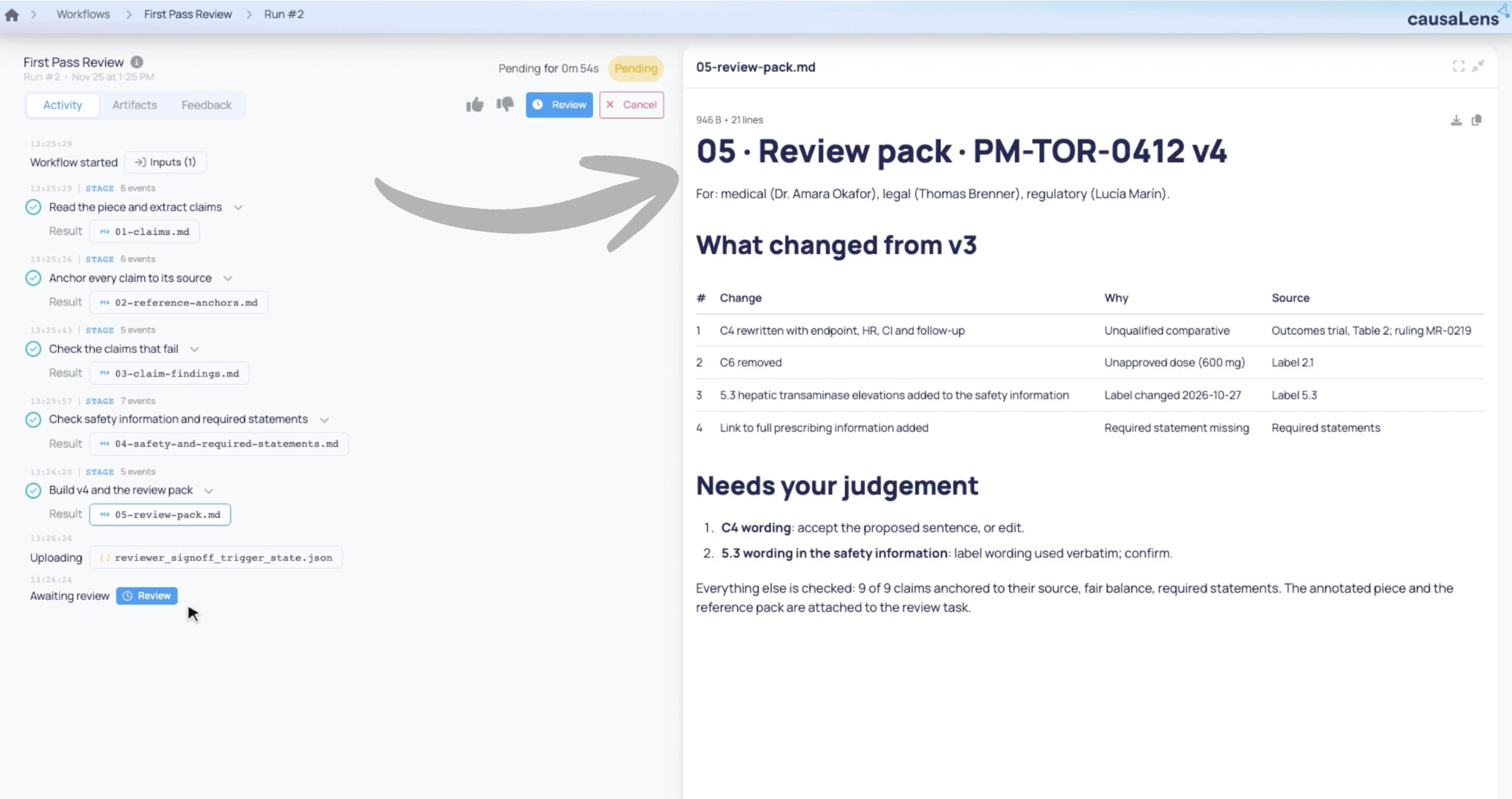
- The Campaign Operations Digital Worker is built for customer engagement and media operations teams, not engineers.
- It does the checking, chasing and building that sits between MLR approval and live media, and brings your team in only for decisions that are theirs to make.
- Your lead pushes the campaign to the ad server, and every check, question and answer is in the run’s audit log.
Plugged into the content and evidence stack you already run
Illustrative Coverage:
- MLR approval certificates and approved asset versions
- Promotional content management systems (e.g. Veeva Vault PromoMats)
- Agency-delivered creative: banners, video and rich media
- Ad server specs and trafficking sheets
- Media plans and placement details
- Corrections and decisions from past campaigns
Built on the core capabilities of the causaLens Digital Worker platform
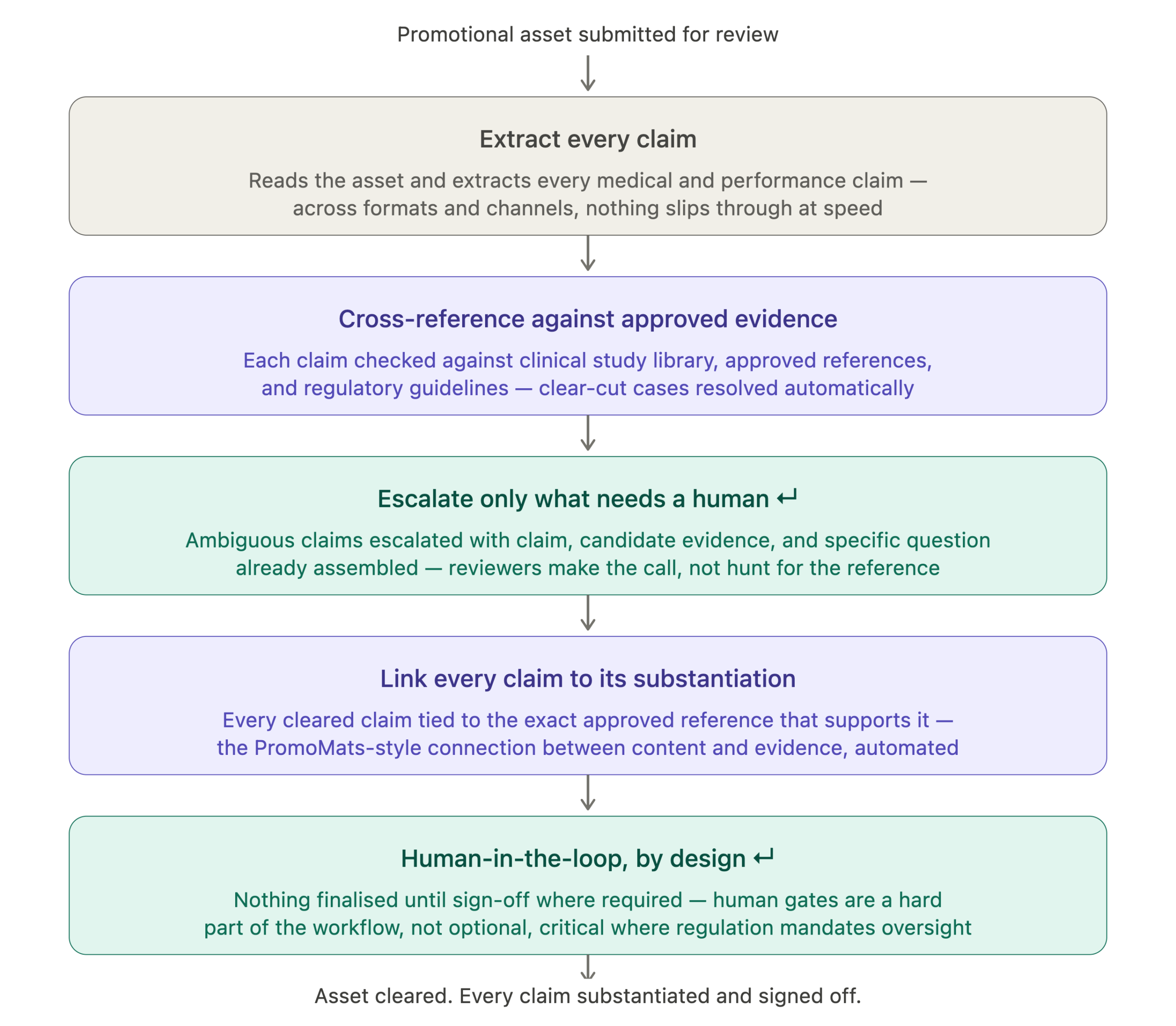
The Campaign Operations Digital Worker is a multi-agent system, governed end-to-end by the capabilities that underpin every causaLens Digital Worker. When the asset going live must be exactly the asset that was approved, reliability is the whole point.
The Multi-Agent Workflow:
This is the capability that separates causaLens Digital Workers from copilots. An evaluation gate means a separate model grades every check, so the Worker never marks its own homework. Exception routing sends decisions that belong to people, such as media-plan questions, to the right lead with the evidence side by side. Provenance tracking wraps every check, question and answer, so the full chain from approval to live media can be audited.
Integrations:
- Promotional content management systems (e.g. Veeva Vault PromoMats), ad servers and agency file sources, integrated via the Agentic Data Mesh
- Your approved large language model: we are model-agnostic and bring-your-own-LLM
- Deployment on causaLens cloud, your private cloud, or fully on-premise
What It Replaces & Reduces:
- Two to three weeks between MLR approval and live media
- Manual asset QA against approvals and ad server specs
- Rounds of agency back-and-forth over fixes
- Manual keying of trafficking sheets into the ad server, and gaps in the audit trail
Common questions, answered
No. The Worker starts once MLR approval lands. It makes sure what goes live is exactly what was approved, and your team still makes the media decisions and pushes the campaign live.
If past campaigns have already settled the question, the Worker applies that answer and cites it. If the decision belongs to your team, it stops and asks the right lead, with the evidence side by side. Nothing is guessed.
PromoMats and similar systems route the MLR review and hold the approved versions. They don’t check what the agency delivered, chase fixes or build the campaign. This Worker picks up from the approval and takes the campaign through to live media.
Yes. We deploy on causaLens cloud, your private cloud, or fully on-premise. The Worker is model-agnostic - use our default model, or bring your own approved LLM. Your data never leaves your environment unless you choose otherwise.
Every check is graded by a separate model, so the Worker never marks its own homework. Anything that fails goes back to the agency with evidence and is checked again on return. Our benchmark suite runs against every release, and we share the methodology during deployment.
Typical timeline: an MVP in two to three weeks against a small, high-value scope, followed by a production deployment scoped to your data, security and integration requirements. A dedicated causaLens AI engineer builds and runs the Worker; a causaLens value engineer owns project success.
Customer engagement, media operations and brand teams at multi-brand commercial companies, plus the agencies and commercial-services partners who deliver their campaigns. No engineering or data-science background is required.
Production-grade, not prototype
Versus manual campaign operations.
No more checking assets by hand, chasing agencies or keying trafficking sheets row by row. Campaigns that took two to three weeks go live in hours, and your team is brought in only for decisions that are theirs to make.
Versus generic LLM tools
A generic model will happily say a campaign is ready without checking it against the approval or the specs. This Worker tests every asset, has a separate model grade every check, and logs every decision. It is auditable, not improvised.
Versus content management workflow alone
Systems such as Veeva Vault PromoMats hold the approval, but the work between approval and live media is still manual. This Worker does that work and records every step.
The Reliability Framework
Evaluation gates, exception routing, institutional memory and a full audit trail. This is the layer that makes campaign automation defensible to your brand, compliance and media teams, trusted because every check is graded and every decision is traceable.