
Every product in the portfolio. Forecast against live actuals. In hours.
The Life Sciences Portfolio Performance Digital Worker pulls actuals from your ERP, live market data from IQVIA and site activation status from Veeva, forecasts every product in the portfolio, and puts a sourced recommendation in front of finance the same day. On approval, it writes the decision back into the systems of record.
Customers automating their workflows













The Current Issue With Portfolio Performance Reviews?
One forecast, three to six weeks, per product
- A single commercial forecast built the traditional way takes three to six weeks. Multiply that by every product in the portfolio and the cycle never closes.
- Analysts extract actuals from Oracle, live performance data from IQVIA and site activation status from Veeva, then rebuild the analysis by hand in Excel every time.
The number is stale and not actionable
- The moment the extract is taken, the model is static. Days later it is drifting; weeks later it is wrong.
- Executives are asked to make capital allocation, pricing and prioritisation calls on a picture of the portfolio that has already moved.
Fragmented Systems & Silos
- The forecast lives in finance. The operational lever - which sites and studies get prioritised - lives in clinical operations.
- Nobody closes the loop, so the decision that should follow the forecast is made late, manually, or not at all.
What Does This Digital Worker Do:
Automates the end-to-end workflow
- The forecast cycle for each product compresses from five or six weeks to a matter of hours, and the whole backlog runs in a single pass.
- Select the products, hand them to the Worker, and a complete near-term forecast and full-year outlook comes back the same day.
Real-time data, not a static extract
- The Worker queries Oracle, IQVIA and Veeva directly at run time, so the outlook reflects the position today - and can be rerun the moment the market or the portfolio moves.
- Analyst capacity moves off extraction and consolidation and onto the judgement calls that actually need a person.
Closes the loop into the systems of record
- Once the CFO approves, the Worker posts the decision back into the ERP and updates site prioritisation in Veeva.
- It also drafts and sends the recommendation and action plan to the relevant owners, so nothing waits on a person to write the email.
blank space
Demo of the Digital Worker:
Select the products. The Digital Worker runs the cycle.
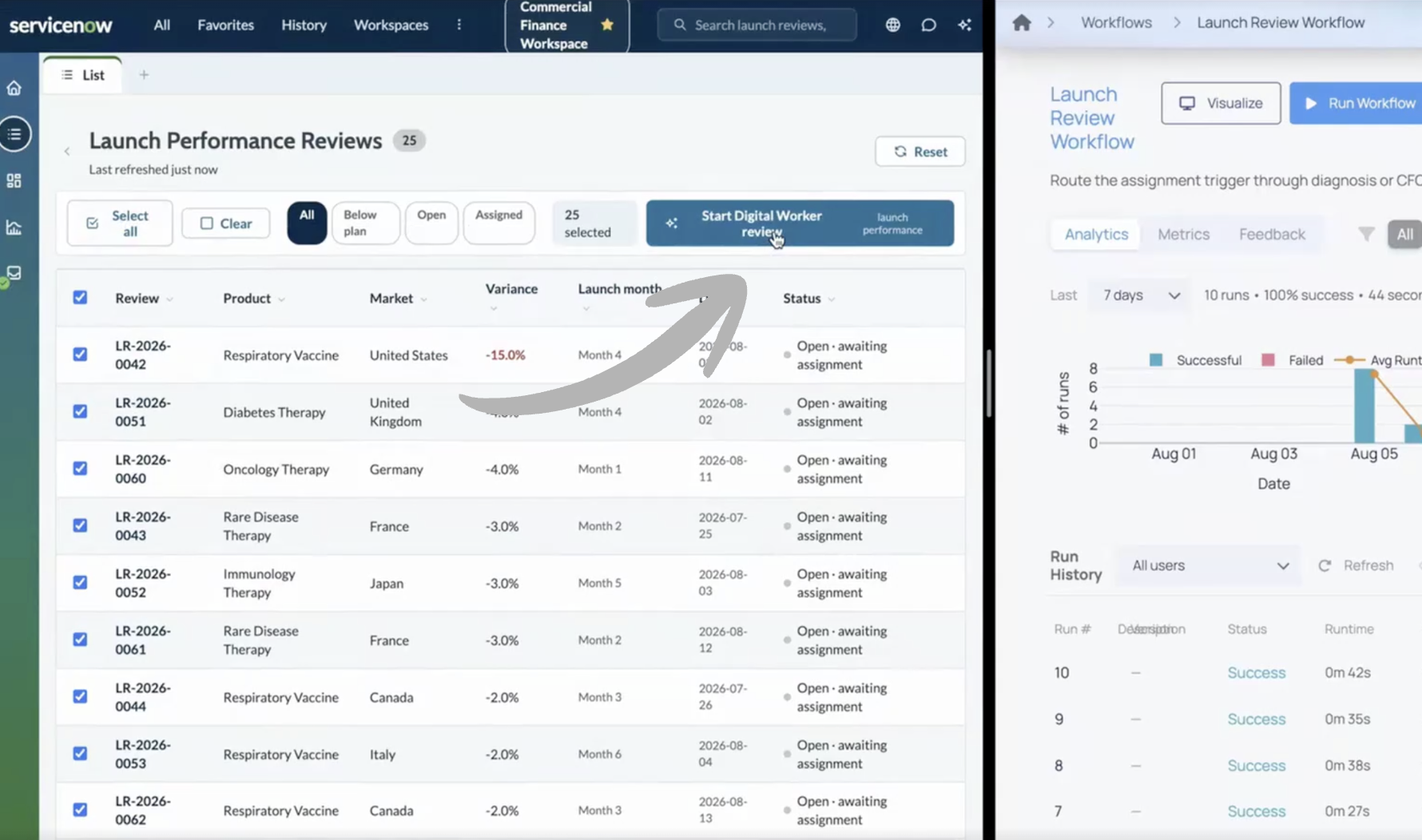
- This Digital Worker is invoked like any other analyst - emailed, @-mentioned, or handed a selection of products from the backlog.
- It runs the whole review from "forecast these products" to "decision approved, systems updated, audit trail filed."
Built for the teams that own the number
- FP&A and finance business partners - running near-term forecast and full-year outlook across a product portfolio, every cycle.
- Commercial and portfolio analytics - who spend the cycle extracting and consolidating IQVIA and ERP data rather than analysing it.
- CFO and finance leadership - who need to approve a decision on live data, with the basis for it visible and auditable.
- Clinical operations and portfolio management - where site and study prioritisation has to follow the financial picture, not lag it.
- Pharma, biotech and CROs - where the breadth of the portfolio and the number of source systems make manual coverage impossible.
Built on the core capabilities of the causaLens Digital Worker Factory
The Life Sciences Portfolio Performance Digital Worker is a multi-agent system of long-running agents, governed end-to-end by the capabilities that underpin every causaLens Digital Worker. These are what make it safe to let an agent produce a number a CFO signs off on.
Core Architecture:
A dynamic query layer over Oracle, IQVIA, Veeva and your ITSM. The Worker reasons over financial actuals, market performance and clinical operational status in a uniform way rather than through a chain of manual extracts - and the same workflow redeploys onto a different ERP or data provider without a rewrite.
Integrations:
- Oracle ERP, IQVIA, Veeva, ServiceNow and your existing forecast models
- Email for recommendation circulation, escalation and approval
- Your approved large language model - we are model-agnostic and bring-your-own-LLM
- Deployment on causaLens cloud, your private cloud, or fully on-premise
What It Replaces & Reduces:
- Five to six weeks of manual analysis and forecasting per product
- Extraction and consolidation of ERP, IQVIA and Veeva data into static spreadsheets
- Executive decisions made on a forecast that is already weeks out of date
- Manual re-keying of approved decisions back into the ERP and Veeva
Common questions, answered
Out of the box: Oracle ERP, IQVIA, Veeva and ServiceNow, with email for review and approval. Because it works through the Agentic Data Mesh, the same workflow redeploys onto a different ERP, data provider or clinical system without rewriting the logic.
No. The Worker produces the near-term forecast, full-year outlook and a recommendation, then stops. Finance reviews and edits it, the CFO gives final approval, and only approved decisions are posted back to the ERP and Veeva - each with a full audit trail.
Every artifact is schema-validated by in-loop judges at each stage boundary, structured values are handled through traceable tools rather than free text, and full provenance links every figure back to its source record. On benchmark workloads, key metrics without the Reliability Framework sat under 20%; with in-loop and out-of-loop validation applied, all move north of 80%, with precision and accuracy over 90%.
The whole portfolio. Coverage is the point: because the mechanical work is absorbed by the Worker, the products that today carry last quarter's number get the same treatment as the flagship brands.
Those platforms store and model the number. They do not go and get the actuals, the IQVIA performance data and the Veeva site status, reconcile them, form a recommendation, circulate it for approval and write the decision back. This Worker closes the cycle, not just the model.
Typical timeline: an MVP in two to three weeks against a defined slice of the portfolio, followed by a production deployment scoped to your systems, security and integration requirements. A dedicated causaLens AI engineer builds and runs the Worker; a value engineer owns project success.
FP&A, commercial analytics, portfolio management and the CFO's office. No engineering or data-science background is required - the Worker is invoked the way your team already works, by email or in chat.
Production-grade, not prototype
Versus the manual cycle
Five to six weeks per product becomes hours across the whole portfolio. The extraction, consolidation, analysis and forecast happen without anyone re-keying between Oracle, IQVIA, Veeva and Excel - and the CFO still signs off.
Versus generic LLM tools
Generic LLMs drop rows, invent figures and keep no audit trail - unacceptable when the output is a full-year outlook. This Worker handles every structured field through traceable tools and is governed end-to-end by the Reliability Framework.
Vs FP&A & planning tools
Planning platforms hold the model; they do not gather live actuals, IQVIA data and Veeva status, reconcile them, recommend, route for approval and post the decision back into the ERP and Veeva. This Worker runs the cycle.