
Every ticket. Every pull request. Against every policy. Every Day.
Reviews 100% of engineering activity against your policy catalog. Auto-clears the routine. Surfaces only genuine exceptions - evidence, owner, remediation attached. Executes approved fixes. Full audit trail.
Customers automating their workflows













The Current Issue With IT Compliance Reviews?
It runs on largely on tribal knowledge
- Compliance decisions rely on experience to match clauses, assign remediation owners, and prioritise breaches — producing inconsistent outcomes between reviewers.
- Leaked secrets, dormant accounts, and SLAs about to breach are easily missed with no systematic coverage checks.
Capacity caps coverage, so most activity is never reviewed
- At realistic volumes - 1000s of tickets and pull requests a month - only a sample can be actively reviewed.
- The rest pass through as silent acceptances. A team of 8–10 specialists spending two to three hours each on manual sampling still only sees a fraction of the surface.
Failures surface weeks later - by an auditor/ incident
- Because review is sampled and after-the-fact, genuine compliance failures are typically discovered long after they occur.
- The first time anyone notices is at the next audit - or, worse, when the gap becomes an incident.
What Does This Digital Worker Do:
Speed to a closed cycle
- What takes a compliance manager 2–3 days of cross-system clicking becomes a single agent run with one human approval gate.
- A complete, sourced report delivered the same day the review is triggered.
Cost saving
- One compliance manager supervises the surface area that previously required a team of 8–10 IT-risk specialists doing manual sampling.
- The mechanical work is absorbed by the Worker.
Coverage, not sampling
- Every item is read against every policy, so the "departed employee still has access" or "leaked secret" class of problem is caught the same day.
- No more finding out weeks later from an auditor or an incident.
Demo of the Digital Worker:
The IT Compliance Digital Worker sits inside the systems the team already uses
Reads everything, clear the routine, surface only the real exceptions
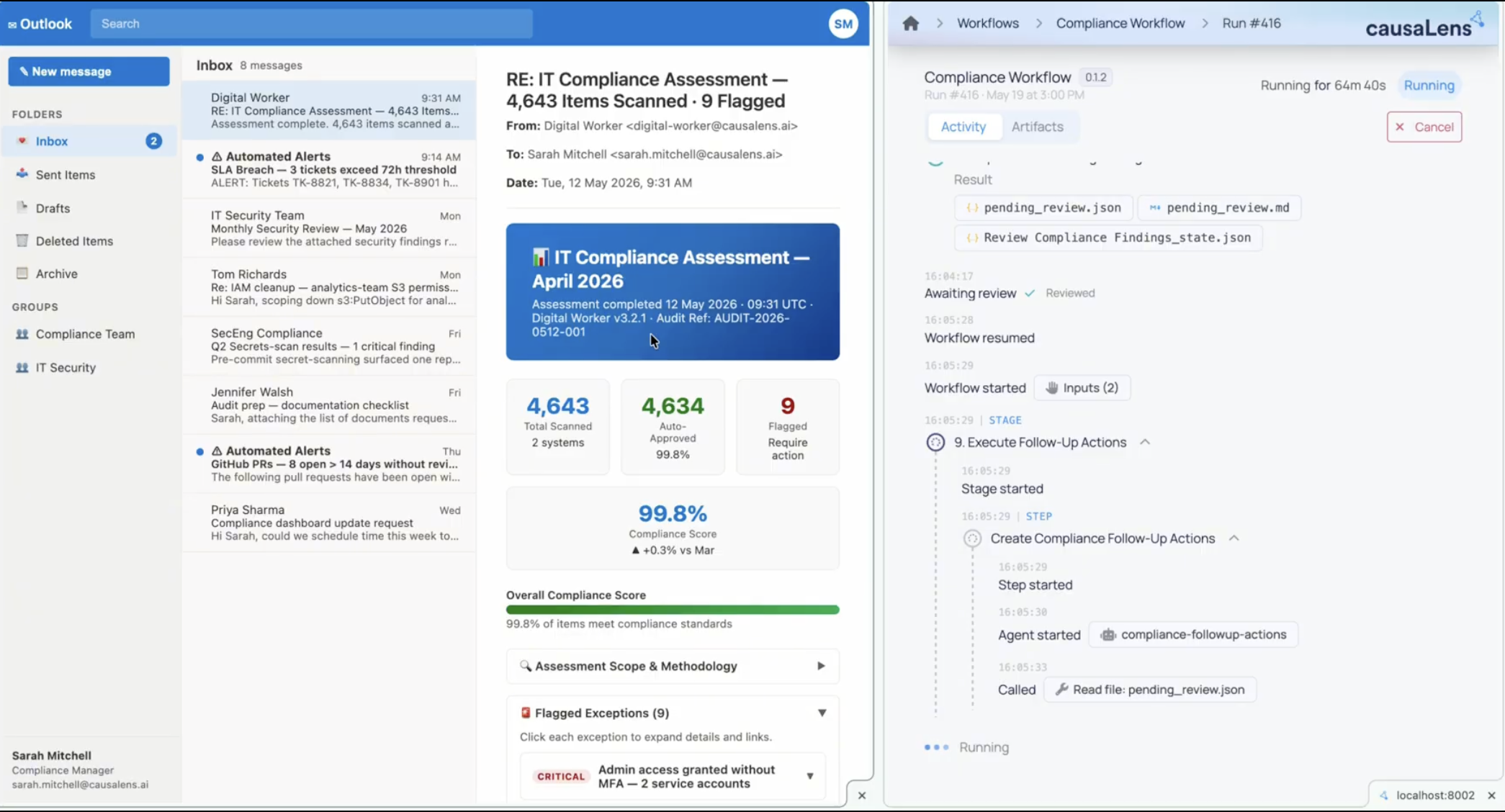
- This Digital Worker can be invoked like any other analyst - emailed, or @-mentioned in the channels your team works in.
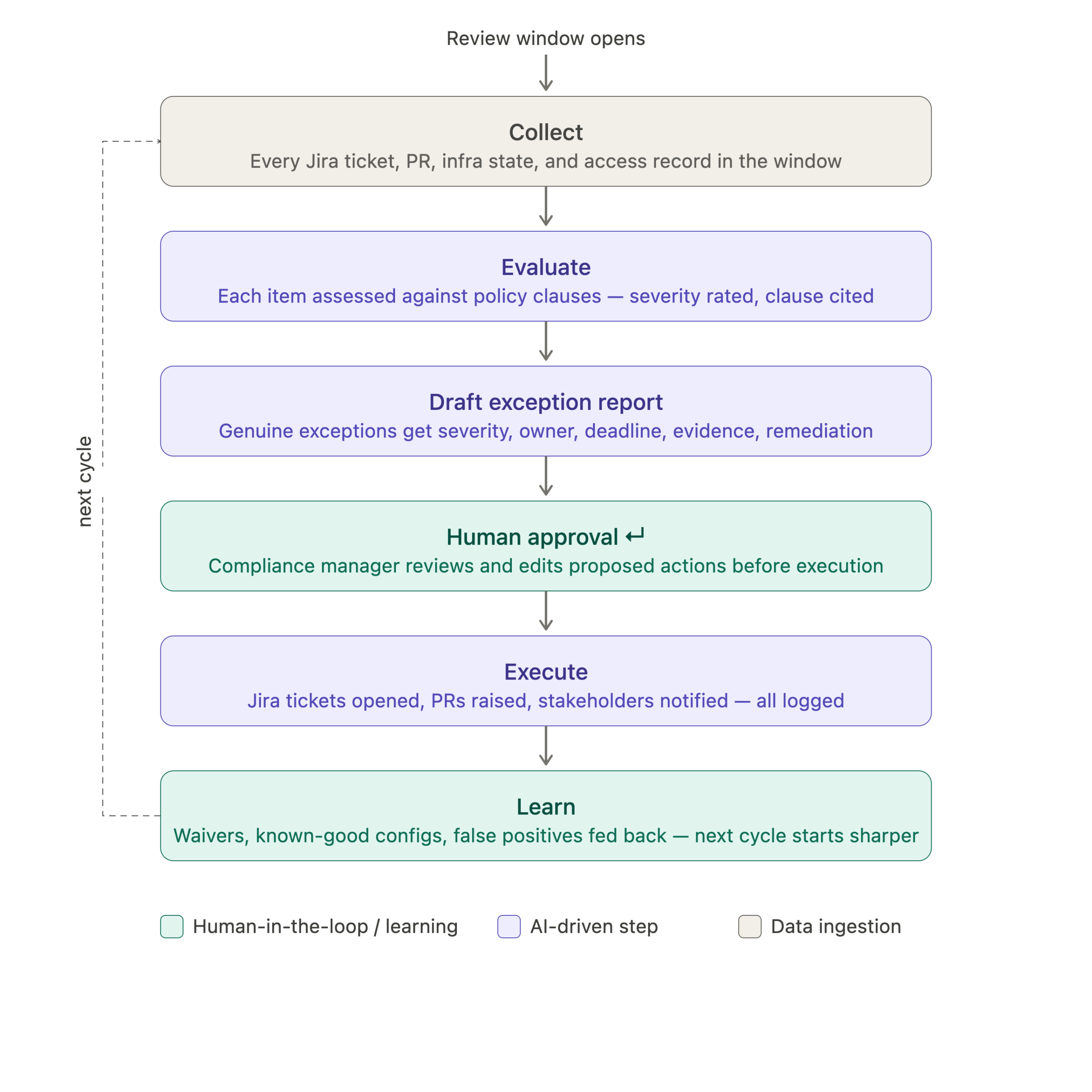
- It runs the whole monthly cycle from “start the review” to “remediations executed and report filed.”
Your compliance cycle. Automated end to end.
Illustrative coverage:
- Jira (and equivalent ITSM / issue-tracking tools)
- GitHub source control - pull requests and change history
- Confluence and your internal policy catalog
- AWS IAM and S3 (and equivalent cloud IAM / storage) access state
- Your company glossary of system classifications
- Slack / email for notifications, escalation and invocation
Built for teams owning engineering compliance & controls
- IT compliance and controls managers - running the monthly review across engineering activity.
- IT risk and GRC teams - who today can only sample a fraction of the surface and want full coverage.
- InfoSec and security engineering - catching leaked secrets and access-control gaps the same day, not at the next audit.
- Internal audit - who need a complete, sourced, reproducible record of what was checked, on what basis, and by whom.
- Regulated engineering organisations - financial services and other industries where every change has to be reconcilable against policy.
Built on the core capabilities of the causaLens Digital Worker platform
The IT Compliance Digital Worker is a multi-agent system, governed end-to-end by the capabilities that underpin every causaLens Digital Worker. These are what make it safe to run autonomously inside a regulated, air-gapped engineering environment.
Core Architecture
A dynamic query layer over Jira, GitHub, Confluence, cloud IAM/storage state, the policy catalog and the company glossary. The Worker reasons over tickets, pull requests, infrastructure config and policy clauses in a uniform way - and the same workflow redeploys to a different stack without a rewrite.
Integrations:
- Jira, GitHub, Confluence, cloud IAM/storage and your policy catalog
- Slack / email for invocation, notification and escalation
- Your approved large language model - we are model-agnostic and bring-your-own-LLM
- Deployment on causaLens cloud, your private cloud, or fully on-premise / air-gapped
What It Replaces & Reduces:
- Manual sampling of a fraction of engineering activity by a team of risk specialists
- Cross-system clicking to gather evidence and identify owners
- Inconsistent, reviewer-dependent interpretation of policy clauses
- Compliance gaps discovered weeks later by an auditor or an incident
Common questions, answered
Out of the box: Jira, GitHub, Confluence, cloud IAM/storage state (e.g. AWS IAM and S3) and your internal policy catalog and glossary. Because it works through the Agentic Data Mesh, the same workflow can be redeployed to a different ticketing tool, cloud provider or policy format without a rewrite.
Yes - it is deployed exactly that way today. We deploy on causaLens cloud, your private cloud, or fully on-premise / air-gapped, and the Worker is model-agnostic, so you can bring your own approved LLM. Your data never leaves your environment unless you choose otherwise.
Only after approval. A single human-in-the-loop gate sits at the end of the assessment phase: the compliance manager reviews and edits the proposed remediations, and only the approved actions are executed - each with a full audit trail.
The auto-clearable bulk - the vast majority of items - is filtered out automatically, so only genuine exceptions reach the human. Agentic Memory then learns from each cycle which patterns are known false positives, so noise falls month over month rather than staying flat.
Reliability is the core of the platform. Every artifact is schema-validated by in-loop judges at each stage boundary, and full provenance lets you audit the whole decision chain. On benchmark workloads, key metrics without the Reliability Framework sat under 20%; with the in-loop and out-of-loop validation applied, all move north of 80%, with precision and accuracy over 90%.
Typical timeline: an MVP in two to three weeks against a defined slice of your policy catalog, followed by a production deployment scoped to your systems, security and integration requirements. A dedicated causaLens AI engineer builds and runs the Worker; a value engineer owns project success.
Compliance and controls managers, IT risk / GRC, InfoSec and internal audit. No engineering or data-science background is required - the Worker is invoked the way your team already works, by email or in chat.
Production-grade, Not Prototype
Versus manual sampling
Sampling 10% of activity leaves 90% unreviewed. The Worker reads 100% of tickets and pull requests against every policy, every cycle, and surfaces only the genuine exceptions - turning a multi-day manual job into a single supervised run.
Versus generic LLM tools
Generic LLMs drop rows, hallucinate field values and keep no audit trail - unacceptable when one wrong policy ID lets a real violation clear. This Worker handles every structured field through traceable tools and is governed end-to-end by the Reliability Framework.
Versus GRC and ticketing tooling
GRC platforms track and store; they do not read every ticket and pull request against your policy catalog, gather the evidence, identify the owner and execute the remediation. This Worker closes the loop, not just the register.
The Reliability Framework
In-loop judges at every stage boundary, schema-validated artifacts, a single clean approval gate and full provenance tracking. This is the layer that lets a long-running agent run autonomously inside an air-gapped, regulated environment - and stand up to audit.