
From protocol to priced investigator grant budget - without a line keyed by hand.
The Investigator Grants Analysis Digital Worker is a team of agents - schedule reading, coding, matching and pricing - running on the same governed platform as every causaLens Digital Worker. That platform is what lets a budget team trust it with the number a site will negotiate against.
Customers automating their workflows













No site signs until the grant is analysed
Every protocol starts with days of manual work
Before a single site can sign, someone has to analyse the protocol's schedule of activities and turn it into an investigator grant. That means coding every procedure by hand, then keying each visit into the fair-market-value benchmark, country by country. For a multi-country trial, that is days of work per protocol.
The detail that changes the price sits in the footnotes
A triplicate ECG, a scan that repeats every six weeks, a test that only applies to some patients - the counts that drive the grant are often buried in footnotes, not the table. Miss one and the grant is wrong before negotiation even starts.
Grant requests are missed, and revenue goes with them
Grant teams work through requests in the order they arrive. When volume spikes, some requests are simply never answered. For a CRO, each one is lost revenue; for a sponsor, it is site start-up time the trial doesn't get back.
What Does This Digital Worker Do?
Reads the protocol the way your team does
- Upload the protocol, fill in the study facts you know - indication, phase, countries, benchmark band - and trigger the workflow.
- The Worker reads the schedule of activities: every visit, every procedure and every footnote that changes the counts.
- Before anything is priced, an independent check confirms nothing was dropped and no count contradicts the page.
Builds the budget lines your way
- Consent, eligibility, blood draws, shipping and other routine lines get your house codes, learned from your past grants and your experts' answers.
The remaining procedures are matched against your code catalogue, each code checked before it is used, with the least certain flagged. - Where the protocol doesn't say - a scan with no body region, for example - the Worker stops and asks your budget lead, quoting the row. One answer prices that line at every visit.
Priced, exported, explained
- The Worker builds the grant in your fair-market-value benchmark for every country, enters every line at every visit and exports the priced grant.
- Your team receives the budget and a verification report, with the lines worth a second look on top. Every line keeps its code, the reason and the protocol page it came from.
- While one site's budget is reviewed, the Worker moves on to the next site in the same study.
blank space
Demo of the Digital Worker:
Every line, its code and its source - in one report
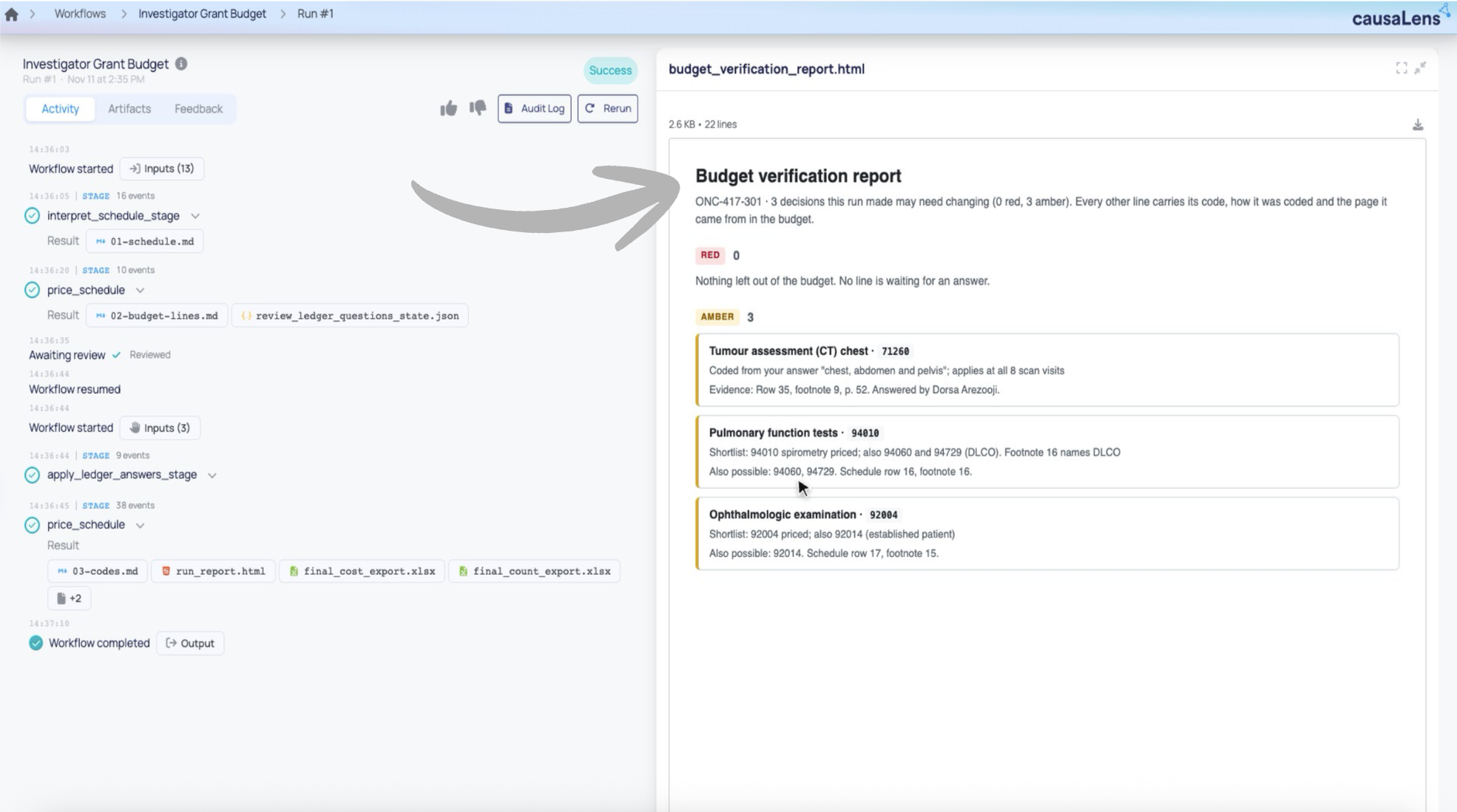
- Built for proposals, site start-up and grant teams, not for engineers.It works across the grant request inbox, the protocol, your code catalogue and your fair-market-value benchmark, and hands back a priced grant alongside a report of every decision it made: how each line was coded, why, and which page of the protocol it came from.
- When the protocol leaves a gap, it asks one clear question, quoting the row, and keeps building the rest of the budget while it waits.
Built on the core capabilities of the causaLens Digital Worker platform
The Investigator Grants Analysis Digital Worker is a team of agents - schedule reading, coding, matching and pricing - running on the same governed platform as every causaLens Digital Worker. That platform is what lets a grant team trust it with the number a site will negotiate against.
Core Architecture:
- Copilots suggest. Brittle automation breaks. Digital Workers keep running.
- The Worker writes its automation as code. When a step fails - a new protocol layout, a changed benchmark screen, a different export format - it diagnoses the failure, repairs the script and carries on. The fix is kept for every protocol after.
- Nothing goes out without a person: wherever the protocol leaves a judgement open, the Worker asks your grant lead. Guardrails stop any agent that drifts, every line links back to the protocol page behind it, and every action lands in the audit trail.
Integrations:
- Protocols and schedules of activities in PDF or Word
- Budget request inboxes - Outlook and equivalents
- Fair-market-value benchmarks for investigator grants
- Your code catalogue and procedure master
- Past budgets and house coding conventions
- Excel and your budgeting or CTMS systems for priced budget output
- Email, calendar and chat - Teams, Outlook and equivalents - for questions and approvals
What It Replaces & Reduces:
- Coding every procedure in the schedule of activities by hand
- Keying every visit into the benchmark, country by country
- Footnotes missed, and budgets wrong before negotiation starts
- Budget requests that never get answered when volume spikes
- Days of start-up time lost waiting on a budget
- Reconstructing how a figure was reached when a sponsor or site asks
Common questions, answered
No. The Worker reads, codes and prices, then hands the budget to your team for review. Wherever the protocol leaves a judgement open, it asks rather than guesses, and the answer is recorded against the person who gave it.
Yes. This Worker is live at one of the world's largest CROs, where it handles the large majority of budget work and answers requests the team previously had no capacity for.
The Worker reads footnotes as part of the schedule, not as an afterthought. Each footnote is tied to the row, column or cell it affects, so a triplicate ECG or a conditional biopsy is priced the way the protocol intends.
Yes. It learns your house conventions from your past budgets and your experts' answers, applies them first, and only matches the remaining procedures against your code catalogue. Every code is checked before use, and the least certain are flagged.
The Worker works inside the fair-market-value benchmark you already use and prices at the band you choose, for every country in the study. We scope benchmarks, countries and output formats against your process during the MVP.
Yes. Every line in the budget keeps its code, the reason for that code and the protocol page it came from, and every question and answer is logged. When a sponsor or site asks how a number was reached, the answer is already written down.
Yes. We deploy on causaLens cloud, your private cloud, or fully on-premise. The Worker is model-agnostic - use our default model, or bring your own approved LLM. Your protocols and budget data never leave your environment unless you choose otherwise.
The Worker needs the same access a person running the process has today: the budget request inbox, your past budgets, the code catalogue and the benchmark, granted through your own credentials and permissions.
Typical timeline: an MVP in two to three weeks against a small, high-value scope, followed by a production deployment scoped to your data, security and integration requirements. A dedicated causaLens AI engineer builds and runs the Worker; a causaLens value engineer owns project success.
It fits right in. Digital Workers run on the systems, data and approved LLM you already have, so there's no new platform to license, integrate and maintain. IT keeps full control over where the Worker is deployed and how it's governed.
Read more: Anti-Platform: The Software Industrial Complex Is Over and Why IT Teams Love causaLens
Production-grade, not prototype
Versus the manual, protocol-by-protocol workflow
Grant teams know how to build an investigator grant. What they lack is the hours: coding dozens of procedures, reading every footnote and keying every visit into the benchmark for every country. So grants take days and some requests are never answered. The Worker does that work for every protocol, and your team reviews a finished grant instead of building one. Capacity stops capping revenue.
Versus templates and spreadsheet macros
Templates speed up the typing, not the reading. They cannot interpret a schedule of activities, tie a footnote to the visits it changes or decide which code a procedure needs. This Worker reads the protocol itself and explains every line it produces.
Versus generic LLM tools
A general-purpose model can summarise a protocol. It cannot be trusted to count every procedure at every visit and price it in a benchmark. This Worker holds budget data in structured, traceable records, checks its own reading before pricing, asks when the protocol is unclear and keeps a full audit trail.