
Inventory Write-off Takes too Long & is Prone to Mistakes
Every close, one question carries real financial risk - and SAP cannot answer it. The Inventory Write-off Digital Worker reconciles every written-off batch against every movement, rebuilds the genealogy, drafts the journal entries, and cites the SAP document behind every line. It never posts on its own.
Customers automating their workflows













The Current Issue With Written-Off Inventory At Close?
Data lives in too many places
Quantities sit in ERP, expiry and batch detail elsewhere, and valuation logic in spreadsheets. Assembling the number takes days of manual pulls and slows you down.
SAP cannot flag written-off stock
A fully written-off batch looks completely normal in SAP, so it keeps getting consumed, sold or shipped. Nobody sees it until someone reconciles by hand.
Reconciliation is outside SoR
A hand-kept spreadsheet on SharePoint is the only place the write-off ledger exists, and matching it back to actual movements takes two to three days every close.
What Does This Digital Worker Do?
It reliably collects data across systems
- It pulls the hand-kept ledger straight from SharePoint - typos, mixed formats and all - and makes clean sense of it in seconds.
- Then it rebuilds each batch's genealogy, raw material through to the finished vials that shipped. That reconstruction costs the team days by hand and is something SAP fundamentally cannot do.
Decides & actions the treatment
- Each batch is resolved to consumed, sold, R&D or untouched, with the Worker scoring its own confidence as it goes and setting aside only the batches it is not sure of.
- Two to three days of work every close finishes in minutes: 100% batches reconciled, ledger 100% current, exposure back to zero.
Drafts the entries, then stops and waits
- It drafts the journal entries across all legal entities. Every line cites the exact SAP document and ledger row behind it, so approving is a review rather than a leap of faith.
- The close memo is written on demand, every figure traceable to its source. You stay the one who decides what actually posts.
blank space
Demo of the Digital Worker:
Share your Rules, Guidelines & Exceptions.
The Digital Worker does the rest.
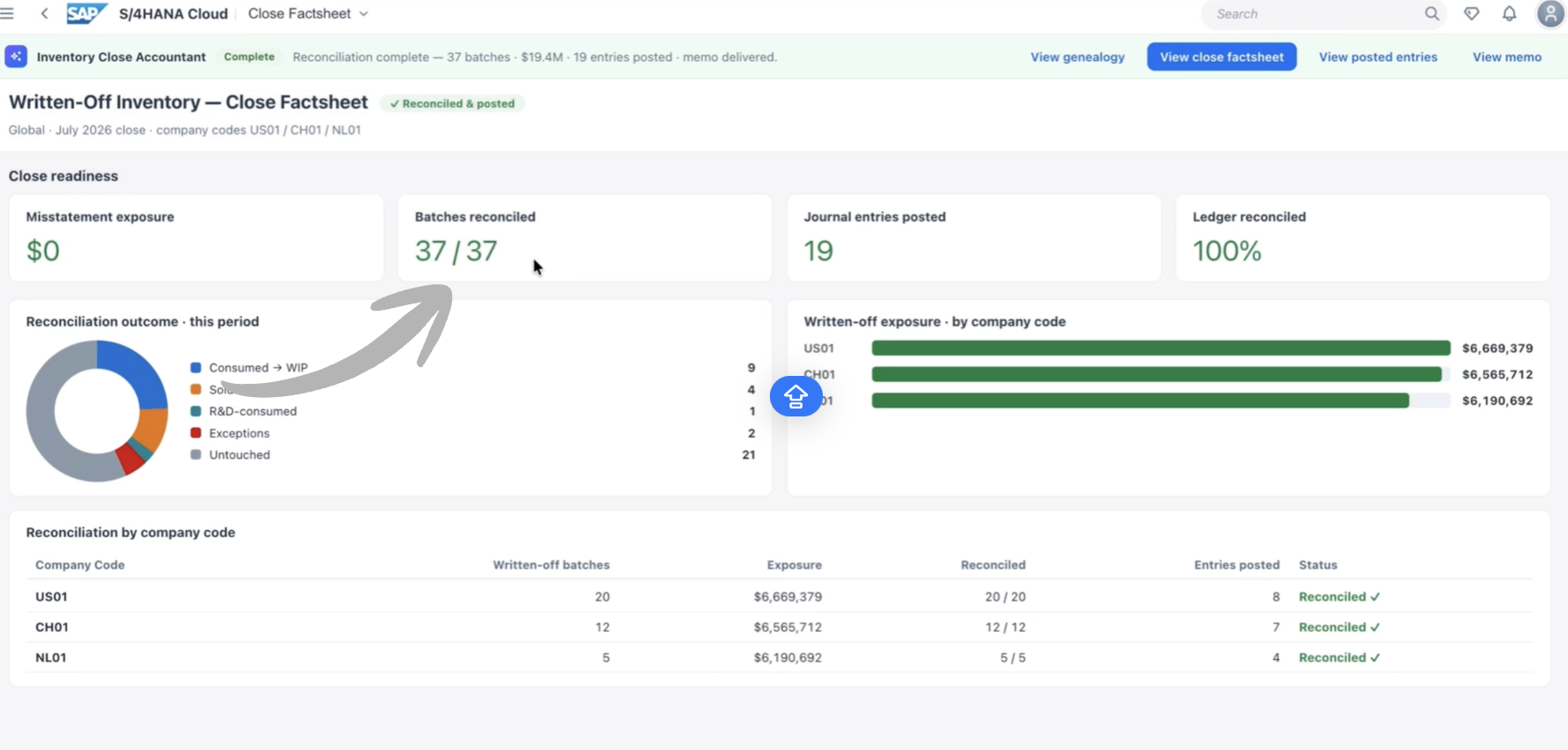
- This Digital Worker is invoked the way you would hand the job to an inventory close accountant - by email, or @-mentioned in the channels your team already works in.
- One screen tells the controller the close is clean: every row marked reconciled, or flagged as still sitting untouched in the warehouse.
Reliable in Production.
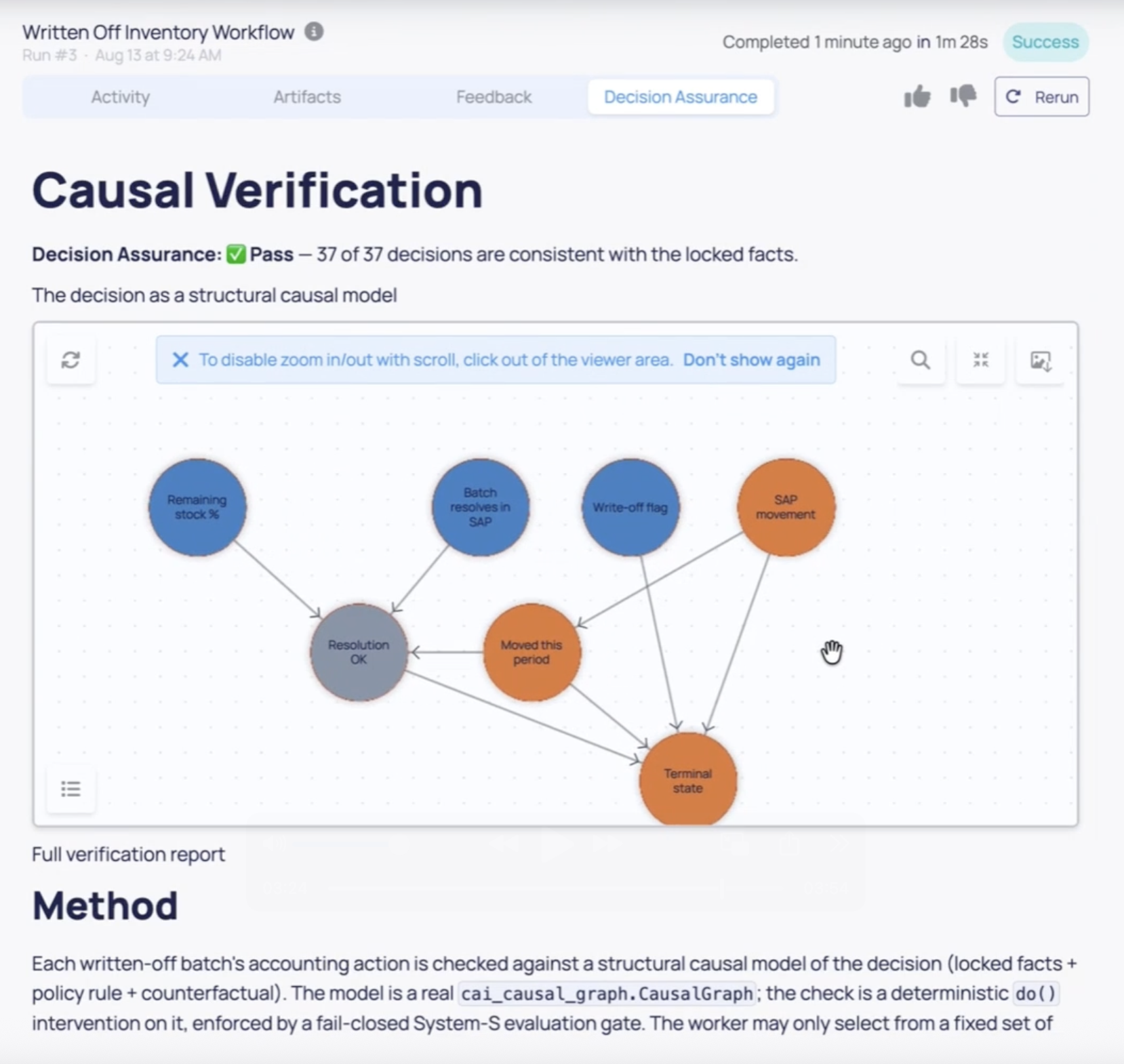
Most automation stops at an audit trail. This Worker goes one step further: it turns every booking into a causal model and tests it.
That is a test of cause, not coincidence. Remove one SAP movement behind a given batch and its booking flips to hold on reserve, because the treatment was driven by real consumption rather than a match that only looked right.
Decisions you can prove, not just trust. That is what lets a Digital Worker touch your books.
Built for the teams that own the close
- Controllers and financial close teams - who carry the misstatement risk on written-off inventory every period.
- Inventory and cost accounting - doing the batch-by-batch comparison by hand against a spreadsheet that should not be load-bearing.
- Internal audit and financial controls - who need a complete, reproducible record of what was checked, on what basis, and by whom.
- CFO and finance leadership - certifying a number whose supporting evidence currently lives outside the system of record.
- Pharma and biotech manufacturers - where write-offs run at around 4% of cost of sales, GMP-certified stock is written down and deliberately retained, and batch genealogy spans multiple legal entities.
Built on the core capabilities of the causaLens Digital Worker Factory
The Inventory Write-off Digital Worker is a multi-agent system built and deployed through the Digital Worker Factory, and it is running against live closes today. These are the capabilities that make it safe to let a Digital Worker draft entries against your ledger.
Core Architecture:
Every booking is converted into a causal model and tested against the facts locked from SAP and the ledger. Remove the movement that drove a treatment and the booking flips - which is how you know the call was caused by real consumption rather than a coincidental match. This is the difference between an automation that shows its work and one that proves it.
Integrations:
- SAP, SharePoint, your general ledger, and your batch and genealogy records
- Email and chat for invocation, review, and approval
- Your approved large language model - we are model-agnostic and bring-your-own-LLM
- Deployment on causaLens cloud, your private cloud, or fully on-premise
What It Replaces & Reduces:
- Two to three days of manual batch-by-batch comparison every close
- A hand-kept spreadsheet outside SAP carrying material financial risk
- Days of manual genealogy reconstruction from raw material to finished goods
- Misstatement exposure on written-off inventory that is still moving
- Good, GMP-certified product expiring because nobody could see it was already written off
Common questions, answered
No. It drafts the journal entries, evidences every line against the underlying SAP document and ledger row, and stops. Nothing posts until a person approves it. You stay the one who decides what actually books.
Because it is tested. Every booking is turned into a causal model and checked against the facts locked from SAP and the ledger. Pull out the movement behind a batch and its booking changes, which is how you can tell the call was driven by real consumption rather than a match that happened to line up.
No, that is the starting point. The Worker reads the hand-kept spreadsheet from SharePoint as it actually is - typos, inconsistent formats, free-text notes - and resolves it in seconds. It does not require you to clean up or restructure anything first.
They are set aside for a human. The Worker grades its own confidence batch by batch and escalates only what it is unsure of, with the evidence it gathered attached - so the reviewer starts from a completed investigation rather than a blank row.
That is what the provenance is for. Every batch scanned, every match made and the evidence behind each call is captured the moment the run finishes, down to the SAP document and ledger row. The trail is reproducible on demand rather than reconstructed months later, which is a stronger control position than the spreadsheet it replaces.
SAP has no concept of written-off inventory. A fully written-off batch looks completely normal, so movements continue against it on operational logic. Reconstructing genealogy across legal entities and reconciling it to a write-off ledger held outside the system is not something SAP is built to do.
Typical timeline: an MVP in two to three weeks against a defined slice of your write-off ledger, followed by a production deployment scoped to your systems, security and integration requirements. A dedicated causaLens AI engineer builds and runs the Worker; a value engineer owns project success.
Production-grade, not prototype
Versus the manual close
Two to three days of batch-by-batch comparison becomes minutes. Genealogy reconstructed, entries drafted and evidenced, close memo written on demand - with the controller still approving every posting.
Versus the spreadsheet
A hand-kept ledger outside SAP is a material weakness waiting to be found. The same reconciliation now runs with structured handling, per-batch confidence and a reproducible trail, and the spreadsheet the team used to keep by hand is kept for them.
Versus RPA and generic LLM tools
Rule-based bots cannot reconstruct genealogy or reason about treatment, and generic LLMs drop rows, invent figures and keep no trail - unacceptable. Every structured value here moves through traceable tools.
Versus automation that just shows its work
An audit trail tells you what happened. A causal test tells you whether the booking is provably right. Every decision is modelled and tested against the facts locked from SAP and the ledger, so approving is a review, not a leap of faith.