
Close the books on what reconciles - and explain what doesn't.
The Finance Reconciliation Digital Worker pulls every system at month-end, flags the material variances, finds the root cause, and recommends the exact correction in the exact system - with the controller's sign-off before anything posts.
Customers automating their workflows













Month-end reconciliation breaks on detection & on resolution
Every system holds a different slice of the truth
At close, the CRM reports closed-won at one total, invoicing reflects another, and the general ledger may already include manual adjustments that downstream systems never received. Finance teams spend days in spreadsheets comparing exports, chasing account owners for context, and debating which system should move - while immaterial timing differences and rounding add noise that makes the real issues harder to find.
Knowing what to change requires cross-functional judgment
Even once a variance is found, knowing what to change - and what not to - takes judgment. Reposting the GL when it already reflects the correct commercial terms creates a second error. Updating the CRM without aligning billing leaves AR out of step with revenue recognition. Each adjustment needs an audit trail tying back to the contract amendment, the reviewer who confirmed the context, and the controller who approved it.
Slow, sequential, and hard to evidence
In practice this means coordinating between revenue operations, billing and controllership in a process that is slow, sequentially dependent, and inconsistent depending on who is available at month-end. Close timelines slip, GL exceptions stay open, and there is no easy way to demonstrate what was checked, on what basis, and by whom.
What Does This Digital Worker Do?
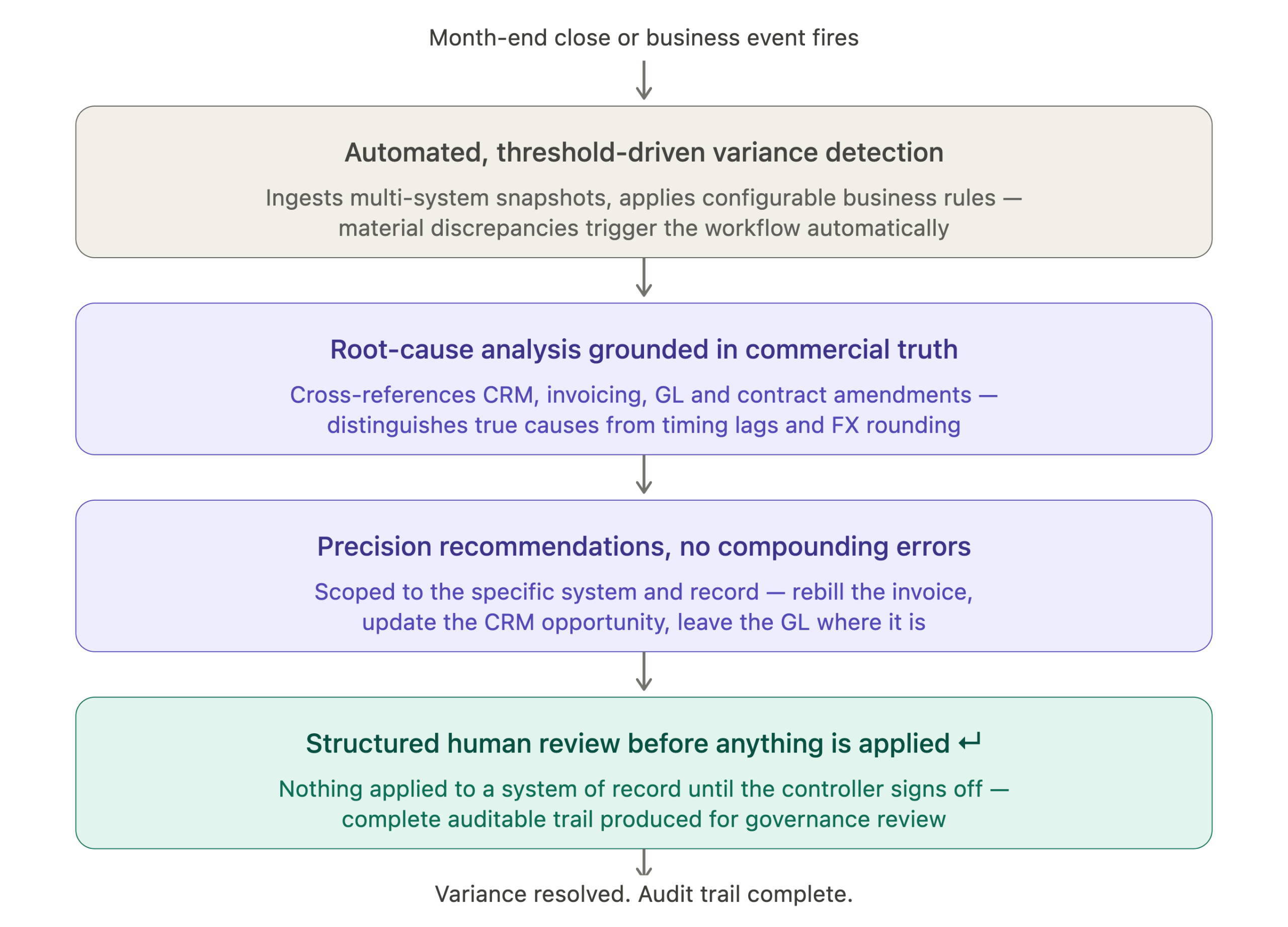
Automated, threshold-driven variance detection
it ingests multi-system snapshots and applies configurable business rules to flag material discrepancies. A variance exceeding your threshold triggers the workflow automatically on a business event such as month-end close - rather than waiting for someone to notice the mismatch in a report.
Automates root-cause analysis
By cross-referencing your systems of record, invoices, and the executed contracts, it identifies the true source of the mismatch and produces a structured analysis that distinguishes likely causes from immaterial noise such as cross-period timing lags and FX rounding.
Provides Precision recommendations
It does not default to journal entries. When the GL is already correct, it recommends rebilling on the invoice and updating the CRM opportunity instead. Each recommended change is scoped to a specific system and record, so the team knows exactly what moves and what stays put.
Detect the variance, find the root cause, recommend the exact fix
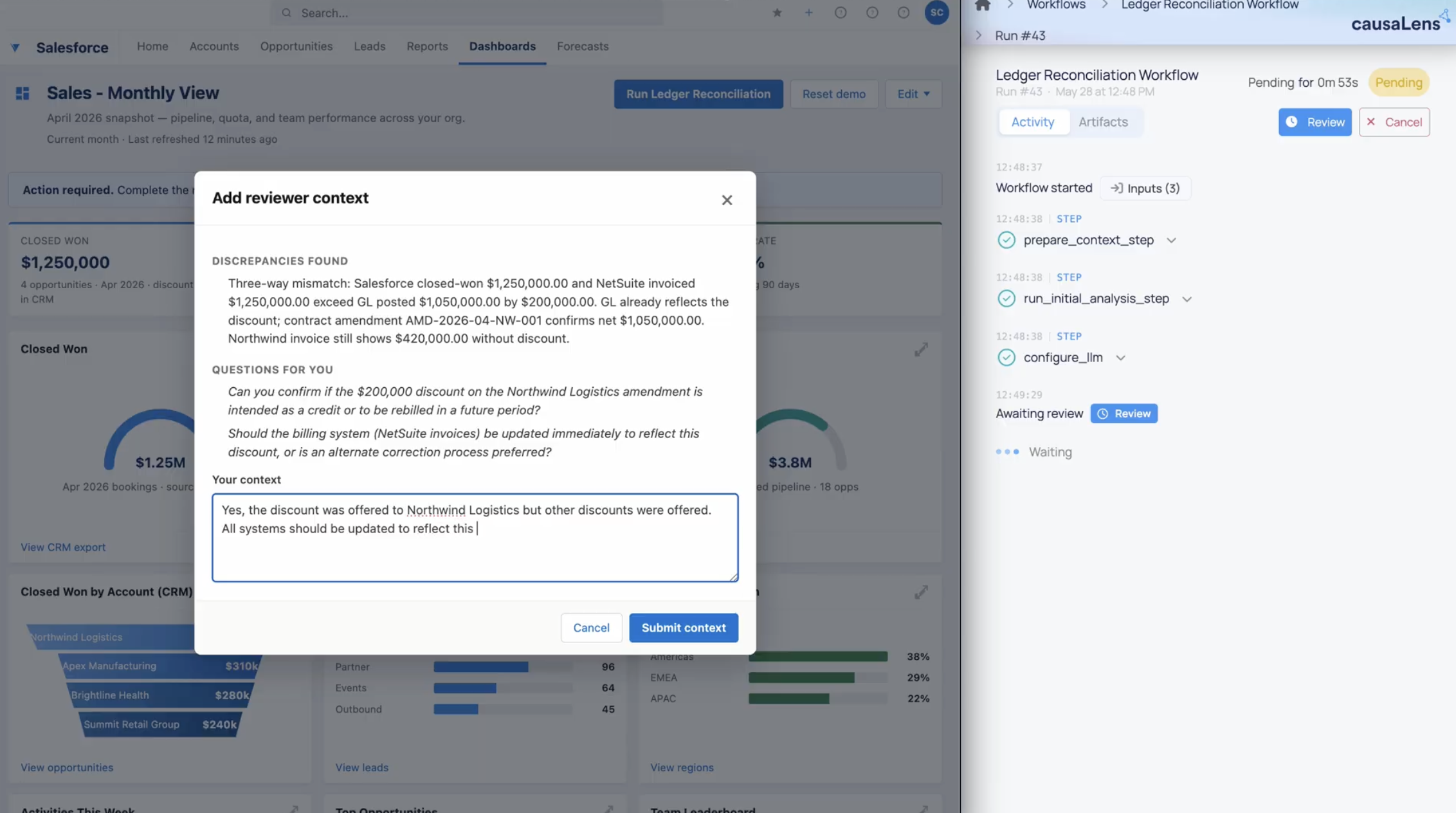
The Finance Reconciliation Digital Worker addresses detection and resolution as a single integrated workflow, rather than treating them as separate concerns handled by separate teams. The value lands in four ways:
Screens against the sources your compliance team already trusts
Illustrative Coverage:
- Sanctions and watchlists (OFAC, UN, EU, HM Treasury and equivalents)
- PEP and adverse-media sources
- Bloomberg and professional/network sources (e.g. LinkedIn) for entity research
- Corporate and beneficial-ownership registries
- Your internal KYC system of record and customer master
- Your case-management and screening platform
Built for the teams that own financial-crime risk
- Controllers and the financial-close team - closing the books on a multi-system revenue stack.
- Revenue operations - keeping CRM, billing and revenue recognition aligned.
- Billing and accounts receivable - resolving invoicing mismatches without creating downstream errors.
- Financial close and consolidation - reducing the open-exception backlog that holds up close.
- Shared services and finance transformation - standardising reconciliation across entities and systems.
Built on the core capabilities of the causaLens Digital Worker platform
The Finance Reconciliation Digital Worker is a multi-agent system, governed end-to-end by the capabilities that underpin every causaLens Digital Worker - the difference between an interesting demo and an automation you can trust with the close.
The Multi-Agent Workflow:
The capability that separates causaLens Digital Workers from copilots. Rules-based variance detection runs before any agent analysis, establishing a deterministic materiality gate, and deterministic fallback logic ensures the workflow completes even if an agent output is malformed. The reconciliation analyst agent states the three-way mismatch, cites the contract amendment as source of truth, rules out incorrect GL reposting, excludes immaterial noise, and asks the reviewer targeted questions; a second judge pass incorporates the reviewer's context to produce the final recommendation. Human review is a hard gate - nothing posts until the controller has reviewed and selected the changes.
Integrations:
- CRM, ERP invoicing, general ledger and contract-management systems
- Your approved large language model - we are model-agnostic and bring-your-own-LLM
- Deployment on causaLens cloud, your private cloud, or fully on-premise
What It Replaces & Reduces:
- Days of spreadsheet comparison across CRM, invoicing and GL exports
- Chasing account owners for the commercial context behind a variance
- Compounding errors from reposting a GL that was already correct
- Manual assembly of the audit trail behind every adjustment
Common questions, answered
Typically CRM (e.g. Salesforce), ERP invoicing (e.g. NetSuite), the general ledger and your contract-management system. Because it works through the Agentic Data Mesh, the same workflow can be redeployed onto a different ERP, CRM or CLM without a rewrite.
No. Human review is a hard gate - nothing is applied to a system of record until the controller has reviewed and selected the recommended changes. And it deliberately avoids defaulting to journal entries: when the GL is already correct, it recommends the right system-specific fix instead, so it never compounds an error.
Rules-based, threshold-driven detection runs first as a deterministic materiality gate, then the agent's root-cause analysis explicitly separates likely causes from immaterial items such as cross-period timing lags and FX rounding - so the team only sees what actually matters.
Every figure is handled through the Structured Data Module - typed snapshots and controlled schemas, never raw into the model - with each amount traceable back to its originating system and contract amendment. This is what eliminates the single-value error that would otherwise corrupt a close.
Not for month-end close specifically - this is a newer blueprint, and we are taking a small number of design partners. The platform it runs on is in production across regulated finance and commercial operations, governed by the same Reliability Framework.
Yes. We deploy on causaLens cloud, your private cloud, or fully on-premise. The Worker is model-agnostic, so you can bring your own approved LLM, and your data never leaves your environment unless you choose otherwise.
We scope a design-partner engagement around one or two high-pain reconciliations, with an MVP typically in two to three weeks, then expand. A dedicated causaLens AI engineer builds and runs the Worker; a value engineer owns project success.
Production-grade, not prototype
Versus spreadsheets and manual reconciliation
Days of export-comparison become a review of a short list of genuine exceptions, each with its root cause and a system-specific fix already worked out - and a complete audit trail produced automatically.
Versus generic LLM tools
In reconciliation, structured-data integrity is the whole game: a single mis-copied or dropped value corrupts the close. Generic LLMs offer no protection against that and no audit trail. This Worker handles every figure through traceable tools and gates posting behind human sign-off.
Versus close and reconciliation tooling
Matching engines tell you that two numbers differ. They do not reason about the root cause across the commercial and accounting systems, and they do not recommend the correct system-specific fix that avoids compounding the error. This Worker closes that gap.
The Reliability Framework
A deterministic materiality gate, deterministic fallbacks, an LLM-judge pass that incorporates reviewer context, and a hard human-in-the-loop sign-off. This is the layer that lets a long-running agent touch the close - controlled, explainable and auditable.