
Most alerts handled Autonomously. Every decision explained. In a fraction of the time.
The AML & KYC Compliance Digital Worker triages alerts, screens names, runs the research and drafts the disposition - autonomously, with a full audit trail and a clear, counterfactual explanation behind every decision your analysts and regulators can stand behind.
In Production:
Proven in production at a global bank, delivered with a Tier-1 global systems integrator - on the same causaLens Digital Worker platform that is live with Syneos Health, Johnson & Johnson and Cisco. Read how a global bank cut its AML false-positive burden →
AML and KYC operations break in 3 predictable ways
Excessive false positives
Legacy rules-based monitoring flags on static thresholds and patterns, so 90–95% of alerts are legitimate activity.
Compliance teams spend their days investigating noise, alert backlogs build, and the volume itself becomes a regulatory risk when genuine signals are dismissed alongside the benign ones.
Screening and research is slow
For every hit, an analyst screens the name, works the watchlist match, researches the entity across Bloomberg, LinkedIn and corporate registries, and chases missing identifiers - date of birth, place of birth, address - by email.
The disposition logic lives in each analyst's head, so two analysts working the same case can reach two different outcomes.
“Why?” is hard to answer
When a customer is offboarded or an application declined for AML/KYC reasons, the institution has to be able to explain why - and under what circumstances the outcome would have been different.
Correlation-based risk scores cannot answer that question. The absence of a clear, reproducible explanation is exactly what auditors and regulators probe.
What does this Digital Worker do?
1) Speed
each alert is triaged, researched and dispositioned in minutes, not hours of analyst time per case. The queue stops growing faster than the team can clear it.
2) Cost saving
the large majority of alerts are dispositioned autonomously, so the throughput of a large analyst pool is delivered by a small supervised team rather than by hiring against alert volume.
3) Better coverage
every alert is reviewed to the same standard, every time. No sampling, no fatigue, no analyst-to-analyst drift, and a defensible reason recorded for every decision.
blank space
Triage, research, disposition - and a defensible reason for every call
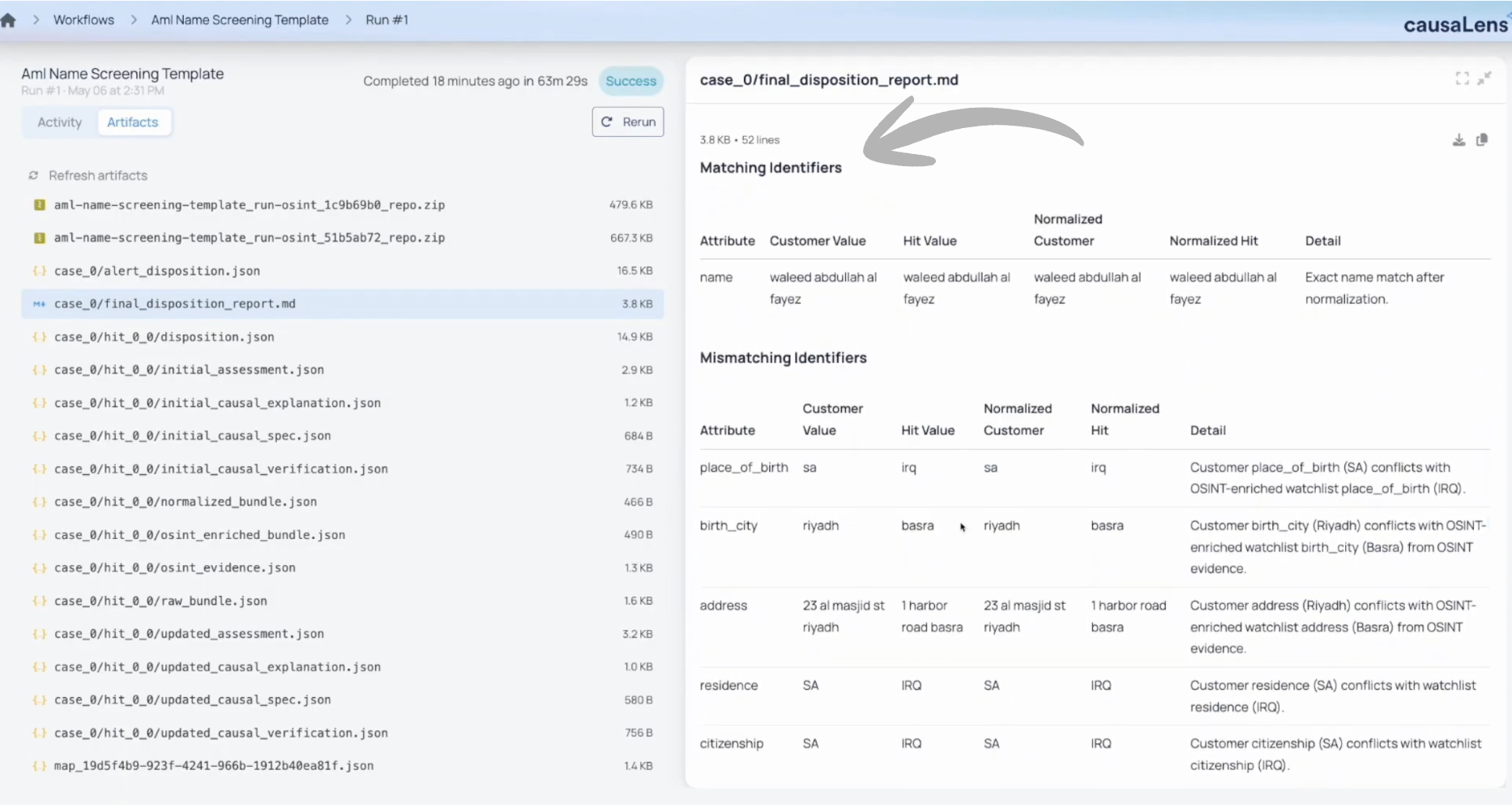
- The AML & KYC Compliance Digital Worker is built for compliance operations teams, not engineers.
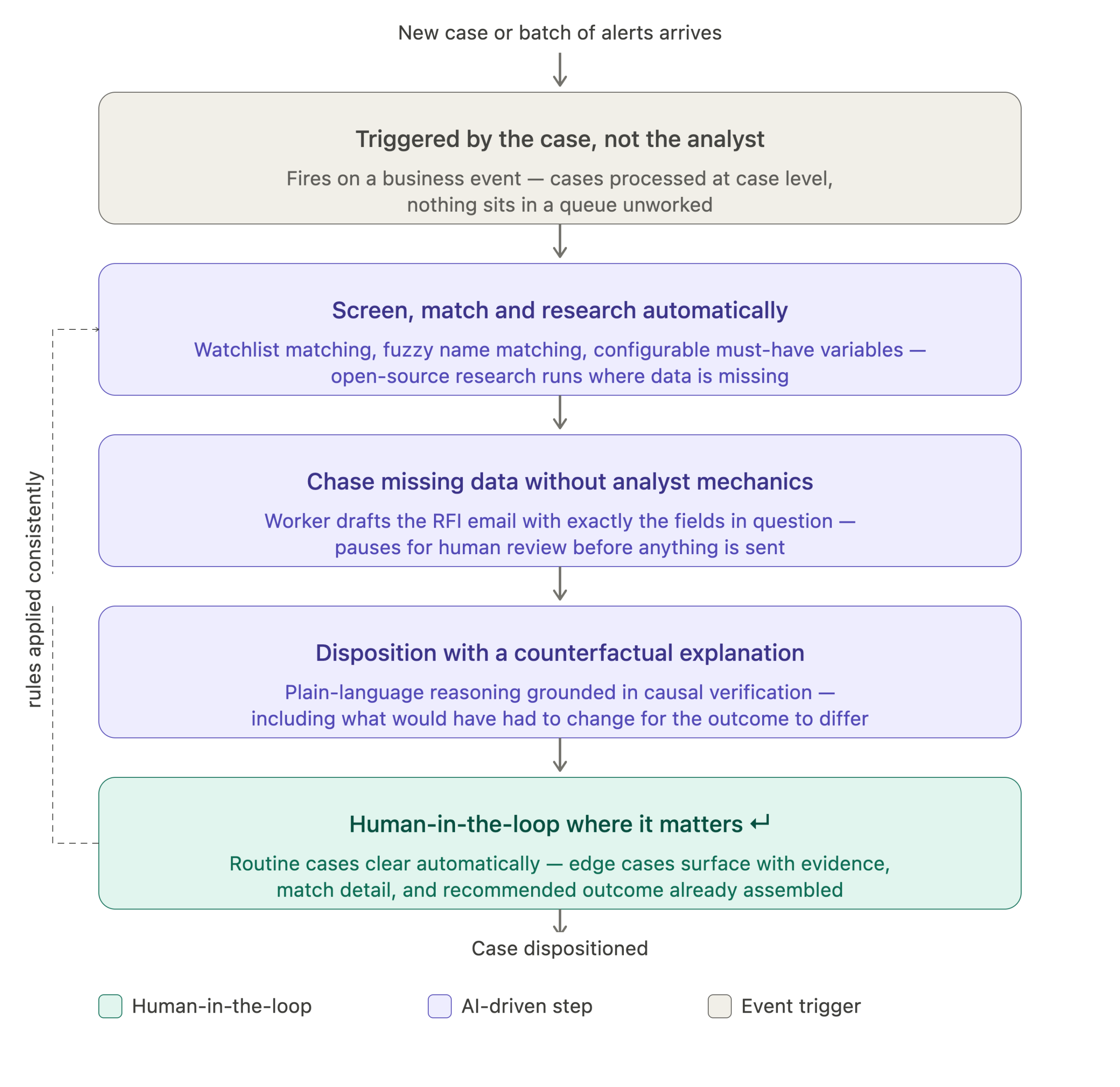
- It picks up a case, screens and researches it across every relevant source, drafts the disposition, and surfaces only the genuine exceptions for human review.
- Built with full provenance and a counterfactual explanation attached to every decision.
Screens against the sources your compliance team already trusts
Illustrative Coverage:
- Sanctions and watchlists (OFAC, UN, EU, HM Treasury and equivalents)
- PEP and adverse-media sources
- Bloomberg and professional/network sources (e.g. LinkedIn) for entity research
- Corporate and beneficial-ownership registries
- Your internal KYC system of record and customer master
- Your case-management and screening platform
New sources and export targets are added through the Agentic Data Mesh
Built for the teams that own financial-crime risk
Screening alerts at volume
Clearing hits, chasing missing identifiers fast.
Watchlist matches worked consistently at scale
Audit trail defensible to regulators
AML/KYC at scale, headcount decoupled
Built on the core capabilities of the causaLens Digital Worker platform
The AML & KYC Compliance Digital Worker is a multi-agent system, governed end-to-end by the capabilities that underpin every causaLens Digital Worker. These are what separate a production-grade compliance automation from a chat interface.
The Multi-Agent Workflow:
A dynamic query layer over watchlists, registries, adverse-media, research sources and your internal customer data. The Worker decides which sources to query for each case, tests and validates them, and remembers the access pattern - so a new licensed feed or internal source can be added in days, not quarters, with no upfront mastering project.
Integrations:
- Watchlist, registry, adverse-media and research sources (see Section 5)
- Your case-management, screening and KYC systems of record, integrated via the Agentic Data Mesh
- Your approved large language model - we are model-agnostic and bring-your-own-LLM
- Deployment on causaLens cloud, your private cloud, or fully on-premise / air-gapped
What It Replaces & Reduces:
- Hours of manual name screening, watchlist disposition and entity research per case
- Email back-and-forth to chase missing identifiers
- Inconsistent, non-reproducible disposition logic that varies between analysts
- The lack of a clear, reproducible explanation when a decision is challenged
Common questions, answered
Out of the box: sanctions and watchlists (OFAC, UN, EU, HM Treasury and equivalents), PEP and adverse-media sources, Bloomberg and professional sources for entity research, and corporate registries - plus your internal KYC system of record and case-management platform. New sources are added through the Agentic Data Mesh, not through hard-coded integration.
Your monitoring system generates the alerts; this Worker works them. It triages and dispositions the routine majority autonomously, researches the genuine cases, drafts the RFI for missing data, and explains every decision - turning a 90–95% false-positive queue into a short list of real decisions for your analysts.
Yes - this is a core design goal. Every disposition is grounded in a causal verification layer and comes with a plain-language, counterfactual explanation: why the decision was reached, and what would have had to be different to change it. Combined with full provenance, that is the standard auditors and regulators look for.
Only where you allow it. Human-in-the-loop gates sit at the points that matter - before an RFI is sent and before a final disposition is committed. Clear-cut cases clear automatically; genuine edge cases are escalated with the evidence already assembled.
Yes. We deploy on causaLens cloud, your private cloud, or fully on-premise / air-gapped. The Worker is model-agnostic - use our default model or bring your own approved LLM. Your data never leaves your environment unless you choose otherwise.
In our deployment the Worker dispositioned the large majority of alerts autonomously and reduced the exceptions reaching analysts by roughly an order of magnitude, with every decision reviewable. At the platform level, the Reliability Framework is what makes this dependable: on benchmark workloads, precision and accuracy without the framework sat under 20%, and with the in-loop and out-of-loop validation applied all key metrics move north of 80%, with precision and accuracy over 90%.
Typical timeline: an MVP in two to three weeks against a priority slice of your alert queue, followed by a production deployment scoped to your data, security and integration requirements. A dedicated causaLens AI engineer builds and runs the Worker; a causaLens value engineer owns project success.
AML and KYC analysts, sanctions and screening teams, and compliance leadership. No engineering or data-science background is required - the interface is built around the dispositions and reviews your operations team already performs.
Production-grade, not prototype
Versus rules-based transaction monitoring
Static thresholds generate 90–95% false positives and cannot explain themselves. The Worker dispositions the routine majority autonomously, surfaces the genuine exceptions, and attaches a causal explanation to every decision.
Versus generic LLM tools
Generic LLMs are not built for regulated work. They have no provenance, no audit trail, and no protection against a hallucinated identifier corrupting a case. This Worker links every value to its source, applies your disposition logic consistently, and is governed end-to-end by the Reliability Framework.
Versus building it on cloud primitives yourself
The hard part is not calling a model - it is reliability, structured-data integrity, memory and explainability on long-running, regulated workflows, plus the time to deploy. The factory builds a configured implementation per institution in days, not the six-to-twelve-month, hundred-person programmes these projects traditionally take.
The Reliability Framework
In-loop judges, hard-stop guardrails, provenance tracking and benchmark-first development. This is the layer that turns a long-running agent into a production-grade automation - trusted by compliance leaders, defensible to an MLRO, and auditable for regulators.