
Every campaign, every DSP - monitored, QA’d and optimised, automatically.
The Media Execution & Optimization Digital Worker runs the day-to-day operations of a multi-DSP programmatic media team.
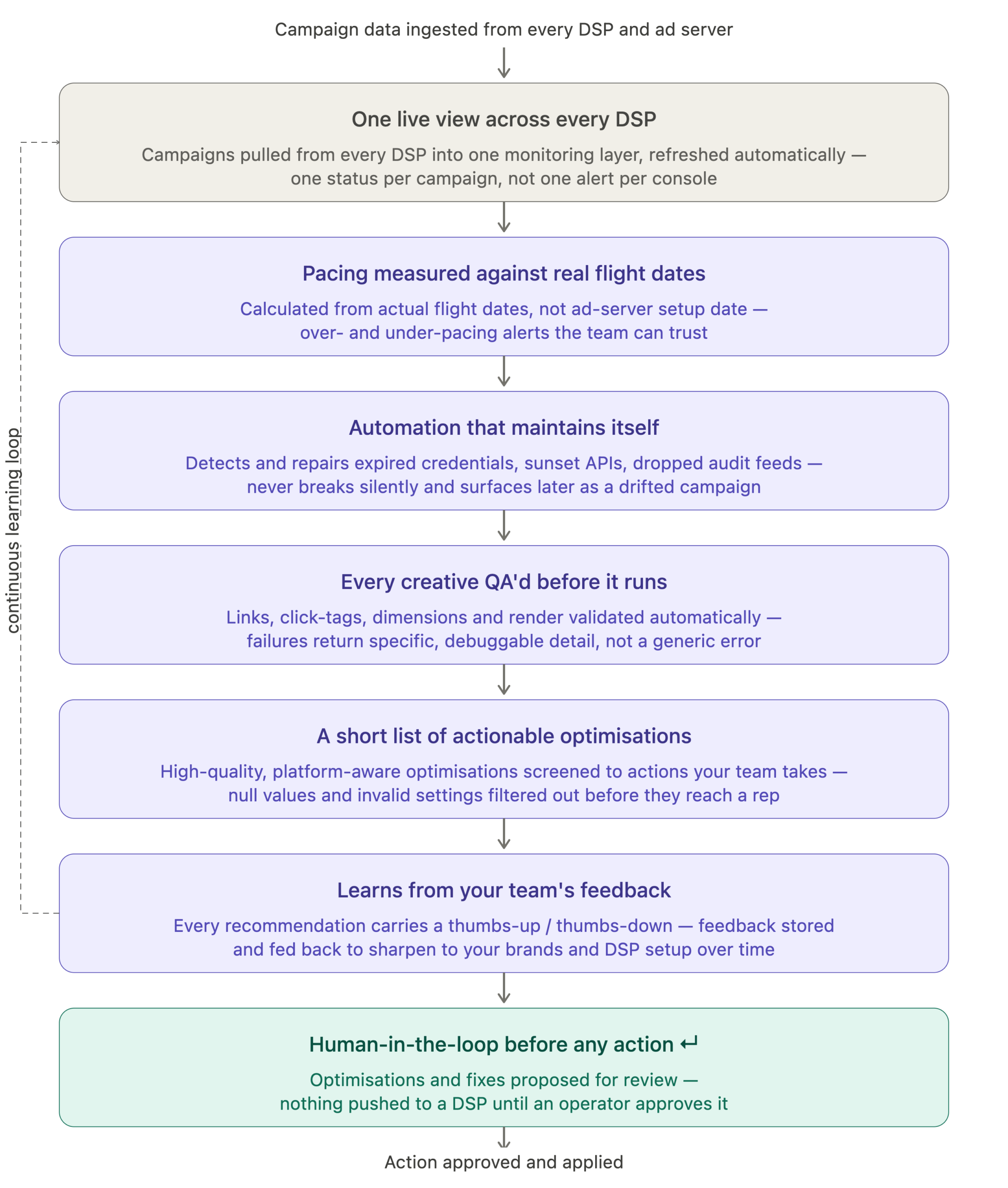
It pulls every campaign into one live view, checks pacing against real flight dates, QAs every creative before it goes live, and surfaces a short list of actionable optimisations
Customers automating their workflows













Programmatic media operations is a fragile, juggling act
Every DSP is its own island
Campaigns run across many DSPs and ad servers, each with its own console, its own alerts and its own export format.
The data is stitched together by hand - often matched on name strings rather than stable IDs - so the same campaign throws separate, unreconciled alerts on every platform and there is no single view of how it is actually doing.
Creative QA is unreliable
HTML creatives are checked by hand against blunt pass/fail rules.
Failures come back with generic error messages a developer can’t debug, and mis-set size rules let broken creatives through - so problems surface live, in front of the audience, rather than before launch.
The automation breaks silently
DSP credentials expire on their own schedules - some every couple of months - APIs get versioned and sunset, and audit-log feeds quietly stop arriving.
When a connection breaks, nobody finds out until a campaign has already drifted, and the fix is a manual scramble to re-authenticate, re-point or re-forward by hand.
What Does This Digital Worker Do:
Campaign operations, on autopilot
Every DSP and ad server feeds one live monitoring layer, with pacing measured against actual flight dates rather than setup dates - so the numbers your team acts on are right. When credentials expire or an API changes, the automation repairs itself instead of breaking silently.
Quality assurance, automated
Every creative is validated before it goes live - links and click-tags fire, dimensions match the placement, nothing flickers - with error messages a developer can actually act on, not a generic pass/fail.
Fewer, sharper optimisations
Instead of a wall of generic suggestions, the Worker surfaces a short list of actionable optimisations per campaign, screened to the actions your team actually takes - and it learns from your thumbs-up / thumbs-down which ones are worth surfacing.
Demo of the Digital Worker:
One operations layer that watches every campaign, checks every creative, and surfaces only what matters
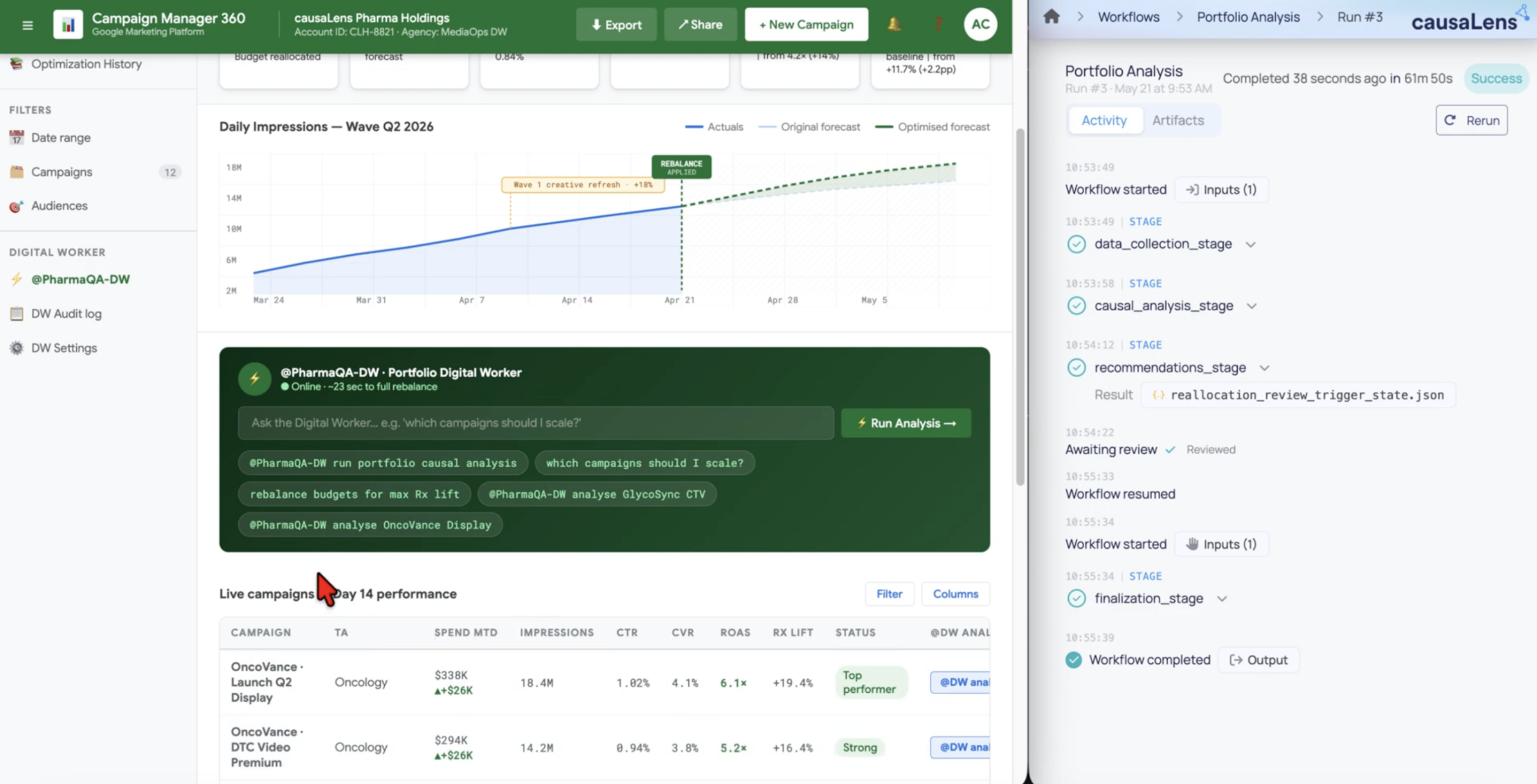
- The Media Execution & Optimization Digital Worker is built for the media-operations team, not for engineers.
- It sits across your DSPs and ad servers, pulls everything into one live view, runs QA automatically, and surfaces a short list of actionable optimisations - with the automation maintaining itself and a human approving any change.
Plugged into the DSPs, ad servers and warehouse you already run
Illustrative of what is already in place:
- Demand-side platforms and ad servers - Campaign Manager 360, The Trade Desk, Pulse Point, Deep Intent, Lasso and others
- Email service providers (ESPs)
- Your data warehouse as the central monitoring layer (e.g. Snowflake)
- Campaign flight dates and pacing / delivery data
- Creative assets and their placement specifications (for QA)
- DSP audit logs and activity feeds
- Budget and spend data by campaign, placement and channel
Built for the teams that run programmatic media operations
- Programmatic and digital media operations teams - running campaigns across multiple DSPs and ad servers day to day.
- Campaign and trafficking managers - responsible for pacing, delivery, and getting creatives live correctly.
- Creative QA and ad-ops specialists - validating that every asset works before it runs.
- Media analytics and performance teams - turning monitoring into the next optimisation decision.
- Agencies and CROs - running media operations for biopharma clients across many brands and platforms.
Built on the core capabilities of the causaLens Digital Worker platform
The Media Execution & Optimization Digital Worker is a multi-agent system, governed end-to-end by the capabilities that underpin every causaLens Digital Worker. These are what make the difference between a fragile set of scripts and an operations layer a media team can run on.
The Multi-Agent Workflow:
The capability that separates causaLens Digital Workers from copilots and brittle automation. Its self-healing loop is the heart of this Worker: on the first run it writes the automation, then runs it as code; when that code errors - an expired credential, a sunset API version, a blocked audit-log feed - the Worker inspects the failure and patches the script to keep the pipeline alive, saving the fix for next time. Human-in-the-loop gates sit before any DSP action, hard-stop guardrails halt agents that drift, and provenance tracking and benchmark-first development keep the whole thing auditable.
Integrations:
- DSPs, ad servers and ESPs.
- Your data warehouse as the monitoring layer (e.g. Snowflake), integrated via the Agentic Data Mesh
- Your approved large language model - we are model-agnostic and bring-your-own-LLM
- Deployment on causaLens cloud, your private cloud, or fully on-premise
- Direct write-back to DSPs for one-click actions, where the platform’s API allows it (on the roadmap, DSP-dependent)
What It Replaces & Reduces:
- A separate console and a separate alert stream for every DSP
- Pacing calculated off the wrong (setup) date
- Manual creative QA with blunt, undebuggable pass/fail rules
- Walls of generic recommendations, many of them unusable
- Manual audit-log forwarding and silent automation breakages
Common questions, answered
Each DSP alerts on its own campaigns, in its own console, in isolation. This Worker reconciles the same campaign across every DSP into one view, measures pacing against real flight dates, and surfaces a short, actionable list - rather than a separate, noisy alert stream per platform with no way to filter across them.
The Reliability Framework’s self-healing loop detects the failure and repairs the connection or patches the script, so the pipeline keeps running instead of breaking silently. Audit-log ingestion across the DSPs is automated, replacing manual forwarding.
For each HTML creative the Worker verifies that links and click-tags fire, that dimensions match the placement, and that the asset renders without flicker - and reports failures with specific, debuggable detail rather than a generic pass/fail, so a developer can fix the real problem.
No. Optimisations and fixes are proposed for review; nothing is pushed to a DSP until an operator approves it. Direct one-click write-back to a DSP is on the roadmap where the platform’s API allows it.
Yes. Once the baseline operations pipeline is stable, your thumbs-up / thumbs-down feedback and the accumulated audit logs are fed back through Agentic Memory, so recommendations sharpen to your team and your DSP setup. Learning is layered on top of a reliable pipeline, not switched on before one exists.
Yes. We deploy on causaLens cloud, your private cloud, or fully on-premise. The Worker is model-agnostic - use our default model, or bring your own approved LLM. Your data never leaves your environment unless you choose otherwise.
Typical timeline: an MVP in two to three weeks against a small, high-value scope, followed by a production deployment scoped to your data, security and integration requirements. A dedicated causaLens AI engineer builds and runs the Worker; a causaLens value engineer owns project success.
Production-grade, not prototype
Versus the manual, console-by-console workflow
One reconciled view across every DSP replaces logging into each platform and stitching exports by hand. Pacing is right because it is anchored to real flight dates, and the team acts on one status per campaign instead of one alert per console.
Versus brittle in-house scripts
Most media automation is a set of scripts that break the moment a credential expires or an API is versioned. The Reliability Framework’s self-healing loop detects the break and repairs it, so the pipeline stays alive instead of failing silently - and the fix persists for next time.
Versus generic LLM tools
A generic model can’t be trusted to manipulate pacing and spend data or to push actions to a live DSP. This Worker keeps data in auditable tools, QAs its own outputs, gates every action behind human review, and tracks provenance end-to-end.
The Reliability Framework
Self-healing automation, in-loop judges, human-in-the-loop gates and benchmark-first development. This is the layer that turns a long-running agent into an operations layer a media team can rely on - and the reason the automation is still working next quarter.