
Competitive Intelligence: Real-time. More Data Sources. Personalised "so-what".
The Competitive Intelligence Digital Worker turns a research question into a competitive landscape you can stand behind. It defines the criteria, picks the sources that can be traced, reads trial registries, approvals, drug labels and exclusivity records, and returns every therapy with the record behind each value - while your insights team decides what it means for the brand.
Customers automating their workflows













Competitive landscapes take weeks and can't be traced
Every launch decision starts with a landscape
Before a new indication, a second brand or a franchise review, someone has to map the field: every therapy approved or in late-stage trials, who is behind it, how it is given and when it loses exclusivity. That is weeks of desk research across a dozen sources, copied into a spreadsheet by hand.
Nobody can say where the numbers came from
By the time the landscape reaches leadership, half the cells have question marks, sources conflict and nobody recorded which record each value came from. Every challenge in the room sends an analyst back to the start.
The same questions get settled again and again
What counts as late-stage? Which source wins when two disagree? Teams answer these questions on every project, and the answers live in an analyst's head or an old deck. Agencies charge for the same work every month.
What Does This Digital Worker Do?
One question, explicit criteria
- Ask your question once, in plain language - for example, which therapies are approved or in late-stage development for an indication, with sponsor, mechanism, route and exclusivity.
- The Worker turns it into explicit criteria. Where a term is ambiguous, such as "late-stage", it applies the definition your team has already settled, so nobody settles it twice.
- Every step is written down as it happens: what it read, how it reasoned and what it produced.
The right sources, read directly
- The Worker ranks the sources it can trace and starts with the one that lists every candidate, such as the trial registry.
- It then reads approvals databases, drug labels, patent and exclusivity listings and company announcements to fill in each value.
- When a source changes or stops being reliable mid-run, the Worker notices, stops relying on it and turns to a better-evidenced source instead.
A landscape you can defend
- Before anyone relies on it, every row is checked: a therapy is only marked verified if each criterion traces to a source record. Anything that can't be traced yet is flagged, not dropped.
- Open any value and you see the record it came from and how it was derived.
- The longlist goes out with its sources and full decision history, ready for your insights team to interpret.
blank space
Demo of the Digital Worker:
Every therapy, every value, every source - in one view
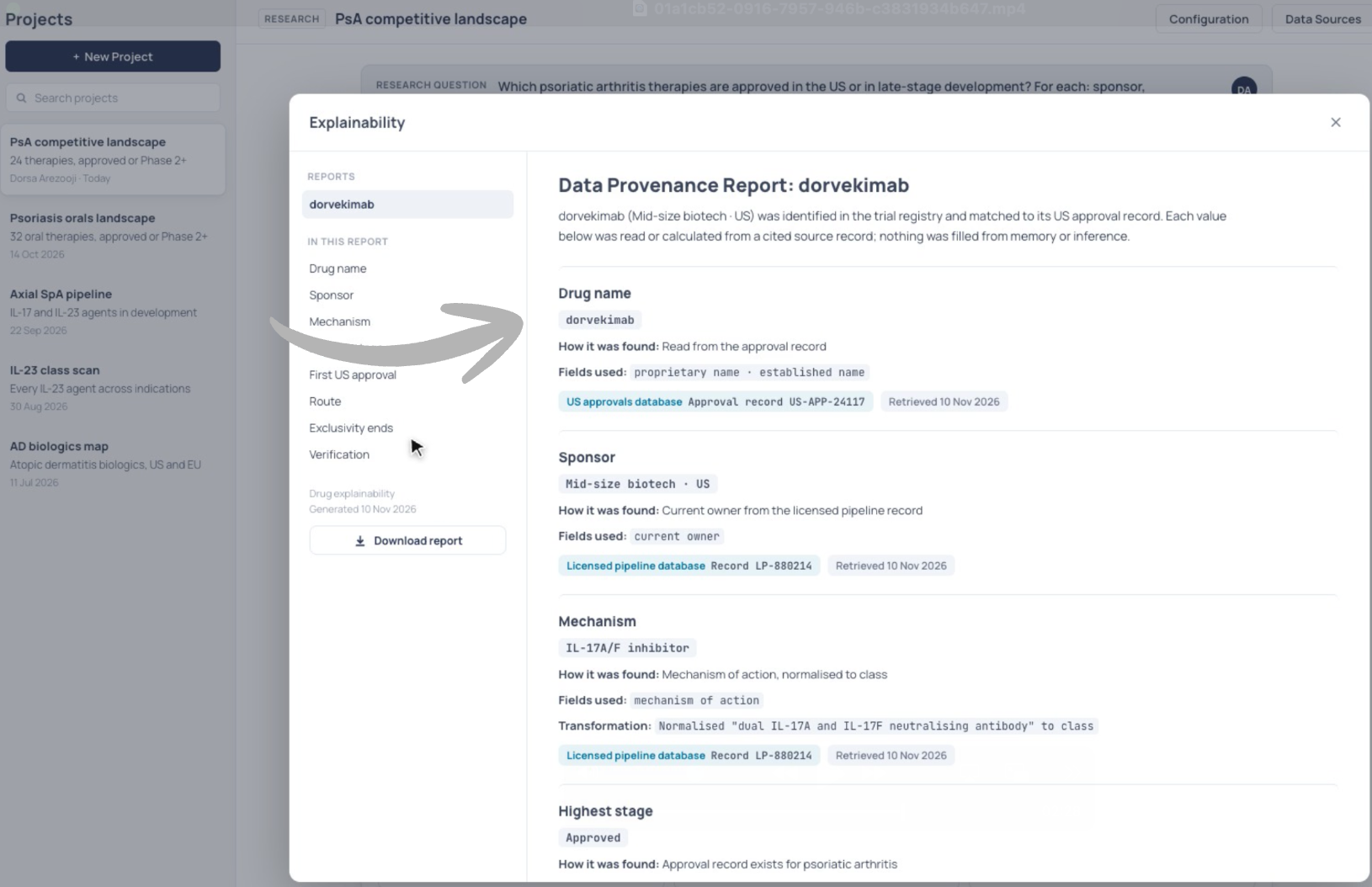
- Built for market insights, new product planning and franchise strategy teams, not for engineers.
- It works across trial registries, approvals databases, drug labels, exclusivity listings and company announcements, and returns a longlist where every value links to the record behind it.
- Each run shows its working step by step - the criteria, the sources chosen and why, the reasoning - so your team can check any finding in seconds rather than redo the research.
Built on the core capabilities of the causaLens Digital Worker platform
The Competitive Intelligence Digital Worker is a team of agents - criteria setting, source selection, extraction and verification - running on the same governed platform as every causaLens Digital Worker. That platform is what turns a research assistant into research your leadership team can act on.
Core Architecture:
- The capability that separates causaLens Digital Workers from copilots and brittle automation.
- The Worker writes its research steps as code. When a source changes its layout or stops returning reliable data mid-run, it detects the change, stops relying on that source and switches to a better-evidenced one - and keeps the fix for next time.
- Guardrails hold every value to a traceable source, every source decision is logged with its basis, and every step lands in the audit trail.
Integrations:
- Clinical trial registries
- Regulatory approvals databases
- Drug labels and prescribing information
- Patent and exclusivity listings
- Company press releases, pipelines and investor materials
- Licensed databases and your internal research
- Excel, PowerPoint and your insights platforms for outputs
What It Replaces & Reduces:
- Weeks of desk research for every new landscape
- Values copied by hand with no record of their source
- Conflicting sources resolved differently on every project
- The same definitions argued over again and again
- Recurring bespoke reports bought from agencies and consultancies
- Analysts re-doing research every time a finding is challenged
Common questions, answered
No. The Worker does the desk research: finding, reading and tracing every value. Your insights team defines the question, settles the definitions and decides what the landscape means for the brand. The Worker gives them the evidence; the judgement stays with them.
Every value links to the source record it came from and shows how it was derived. A therapy is only marked verified when every criterion traces to a record. Anything that can't be traced is flagged with the reason, so you see the gaps rather than discover them later.
The Worker ranks sources by how well they can be traced and logs every choice with its basis. If a source changes its layout or becomes unreliable mid-run, the Worker notices, stops relying on it and moves to a better-evidenced source.
Yes. This Worker is in user acceptance testing at a global biopharma commercial-services company, turning research questions that took weeks into answers returned the same day, with the evidence behind every finding.
The blueprint starts with competitive landscapes: approved and late-stage therapies, sponsors, mechanisms, routes and exclusivity. The same pattern extends to first-in-class analysis, analog research, pipeline tracking and other market research questions. We scope coverage against your therapy areas and markets during the MVP.
Yes. The Agentic Data Mesh is a query layer, not a point-to-point integration, so licensed databases, internal research and new public sources can be added without rewriting the workflow.
Yes. We deploy on causaLens cloud, your private cloud, or fully on-premise. The Worker is model-agnostic - use our default model, or bring your own approved LLM. Your questions, internal data and outputs never leave your environment unless you choose otherwise.
Typical timeline: an MVP in two to three weeks against a small, high-value scope, followed by a production deployment scoped to your data, security and integration requirements. A dedicated causaLens AI engineer builds and runs the Worker; a causaLens value engineer owns project success.
It fits right in. Digital Workers run on the systems, data and approved LLM you already have, so there's no new platform to license, integrate and maintain. IT keeps full control over where the Worker is deployed and how it's governed.
Read more: Anti-Platform: The Software Industrial Complex Is Over and Why IT Teams Love causaLens
Production-grade, not prototype
Versus manual desk research
Analysts know how to build a landscape. What they lack is time to read every source, record where every value came from and keep definitions consistent across projects. So landscapes take weeks and can't be defended line by line. The Worker does the reading and the tracing, and your team spends its time on what the landscape means.
Versus agencies and consultancies
Outsourced reports arrive on a schedule, cost the same every month and rarely show their working. This Worker answers the question when you ask it, inside your own environment, with every source and decision on the record.
Versus generic LLM tools
A general-purpose chatbot will give you a confident landscape with no way to check it. This Worker holds every value to a source record, flags what it can't trace instead of guessing, adapts when sources change and keeps a full decision history.