
Site Budget, Payments & Accruals on Auto-Pilot. With full audit trails. 100% Correct. Without moving any data.
The Site Payments & Trial Accruals Digital Worker runs the monthly trial close. It pulls every completed visit, confirms the patient is still enrolled and the visit was verified by a monitor, prices it from that site's budget and checks every line before anything is paid. Then it builds the sponsor accrual from actual activity, not the enrolment plan - while your clinical finance lead signs off every payment run.
Customers automating their workflows













The trial close still runs on spreadsheets
Hundreds of sites, one month-end
Every month or quarter, clinical finance pays hundreds of sites for the visits they completed. Invoices arrive as Excel files, PDFs or scans, each site's rates sit in its own budget file, and every line is checked by hand against the clinical database, a monitoring schedule and the site agreement - all before the close deadline.
Paying before a visit is verified is easy to do
Accruals are only built from a plan
Sponsors need an accrual they can book, so teams rebuild it from the enrolment plan and true it up months later. When enrolment runs behind or ahead of plan, the books are wrong in the meantime - and nobody can quickly say whether the gap is enrolment or pricing.
What Does This Digital Worker Do?
Every visit priced from the source
- Start the month-end close for a trial and trigger the autonomous workflow.
- The Worker pulls every completed visit from the clinical database and reads the monitoring reports to confirm each one has been source-verified.
- It prices each visit from that site's negotiated budget, pulled line by line from the budget file in your eTMF, so rates are never copied by hand.
Every line checked before money moves
- Each line is checked: patient still enrolled, visit in the EDC and verified, price within that site's budget, and not paid before.
- Failed lines are held with the reason and carried into next month's run. Visits missing only a minor item can still be paid in full.
- The payment run keeps the contractual holdback back. Money only moves when your clinical finance lead signs it off.
An accrual the sponsor can trust
- The Worker builds the accrual from the work actually done, using the same budget rates as the payment run, and compares it with the enrolment-plan estimate.
- Before it goes to the sponsor, the Worker tests the result: it re-runs the estimate with actual visits in place of the plan to show whether the gap comes from enrolment or from pricing.
- Every payment and accrual line traces to its visit, its verification, its budget line and who approved it, with the previous value kept.
blank space
Demo of the Digital Worker:
The payment run, the held lines and the sign-off - in one review
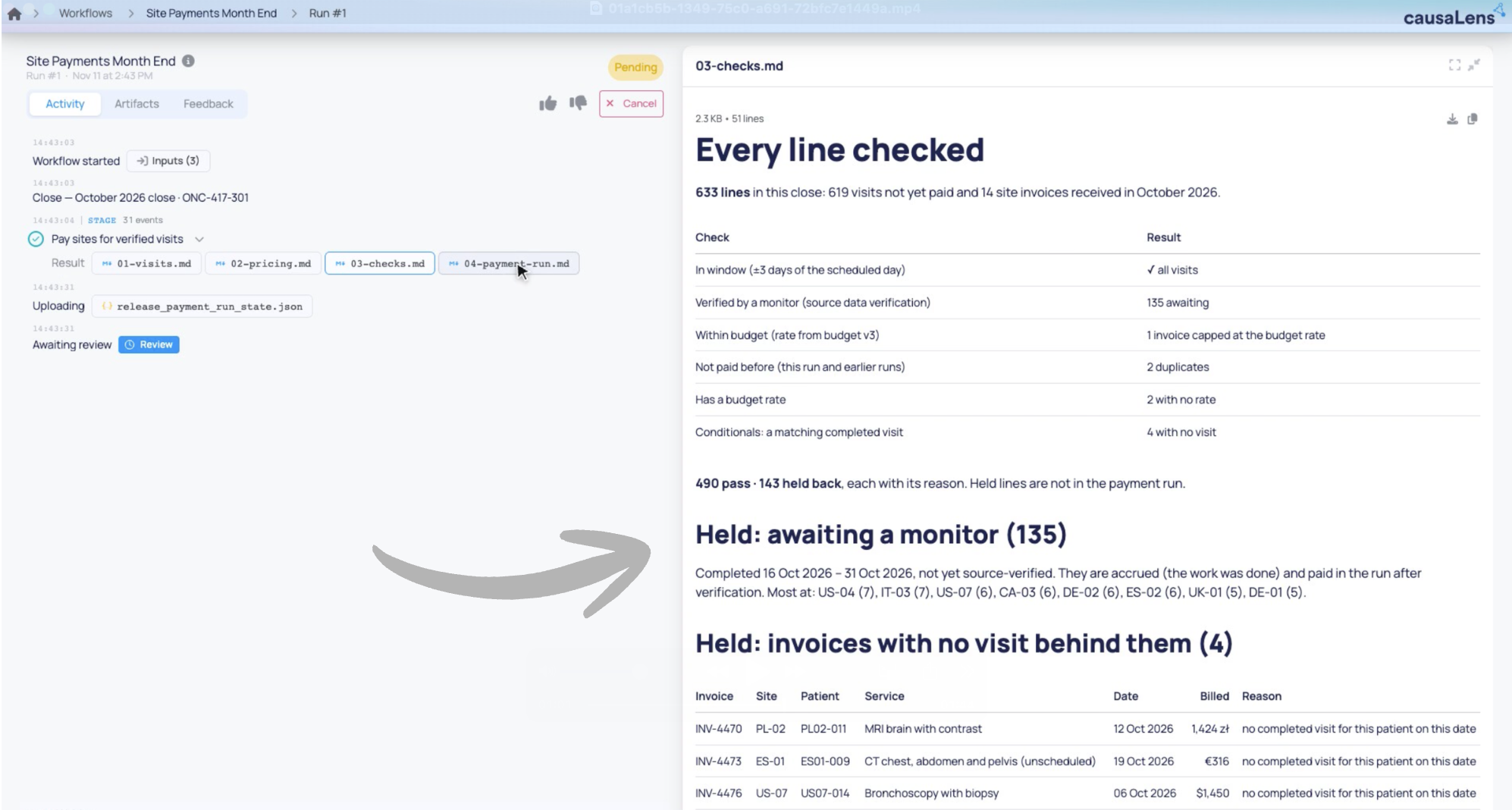
- Built for clinical finance and clinical operations teams, not for engineers.
- It works across the clinical database, monitoring reports, site budgets, site agreements and invoices, and presents a payment run with every held line and its reason - with your clinical finance lead releasing it before anything is paid.
- At the end of the close, it hands over the payment file to accounts payable, the accrual to the sponsor, held visits to next month's run and queries back to sites, each with a full audit log.
Built on the core capabilities of the causaLens Digital Worker platform
The Site Payments & Trial Accruals Digital Worker is a team of agents - visit collection, pricing, checking, payment and accrual - running on the same governed platform as every causaLens Digital Worker. It works on its own from the site budgets you already have, or alongside our Site Budgets & Investigator Grants Digital Worker, so a rate is priced once and used consistently from budget to payment to accrual.
Core Architecture:
- The capability that separates causaLens Digital Workers from copilots and brittle automation.
- The Worker writes its automation as code. When a step fails - a changed clinical database export, a new monitoring report layout, a different invoice format - it diagnoses the failure, repairs the script and keeps the close moving, keeping the fix for next month.
- Guardrails mean the Worker cannot release a payment run on its own. Every run waits for sign-off, every held line carries its reason, and every step lands in the audit trail.
Integrations:
- Clinical databases and EDC systems for completed visits
- Clinical trial management systems and monitoring reports for source-data verification
- Site budgets and site agreements, including holdback terms
- Site invoices in any format, and payment systems such as Coupa
- ERP and general ledger for payments and accrual postings
- Email, calendar and chat - Teams, Outlook and equivalents - for sign-offs and handovers
What It Replaces & Reduces:
- Visit trackers and rate workbooks maintained by hand
- Sites paid for visits not yet verified by a monitor
- Invoices paid for visits or procedures that never happened
- Duplicate payments across months
- Accruals rebuilt from the enrolment plan and trued up months later
- Days spent explaining accrual variances to sponsors and auditors
Common questions, answered
No. The Worker prepares the payment run and stops. It cannot release payments on its own: money only moves when your clinical finance lead signs off, and that approval is recorded against their name.
They are accrued, because the work was done, but held from payment with the reason recorded. They carry forward into the next month's run and are paid once a monitor verifies them.
Most accruals are built from the enrolment plan and trued up later. This Worker builds the accrual from the visits actually completed, priced at the same rates as the payment run, then tests it against the plan-based estimate so the sponsor can see whether the difference is enrolment or pricing.
Yes. It prices visits from your approved site budgets. Paired with our Site Budgets & Investigator Grants Digital Worker, the same coded budget flows straight from start-up into payments and accruals.
Every payment and accrual line traces to its visit, its verification, its budget line and the person who approved it, with the previous value kept. At the end of each close, the Worker produces an audit log of every system it read, every human input and every action taken.
Yes. The Agentic Data Mesh is a query layer, not a point-to-point integration, so trials, sites, countries and currencies can be added without rewriting the workflow.
Yes. We deploy on causaLens cloud, your private cloud, or fully on-premise. The Worker is model-agnostic - use our default model, or bring your own approved LLM. Your trial and financial data never leave your environment unless you choose otherwise.
The Worker needs the same access a person running the process has today: your clinical database, monitoring reports, site budgets and finance systems, granted through your own credentials and permissions.
If every critical item is there, the visit isn't held. Your team chooses full payment with the query kept open, or a partial payment, in line with the site contract.
It fits right in. Digital Workers run on the systems, data and approved LLM you already have, so there's no new platform to license, integrate and maintain. IT keeps full control over where the Worker is deployed and how it's governed.
Read more: Anti-Platform: The Software Industrial Complex Is Over and Why IT Teams Love causaLens
The Worker checks each patient's enrolment status before paying a visit. When a patient drops out or rejoins, finance is told straight away and the accrual is adjusted.
Production-grade, not prototype
Versus the manual, spreadsheet close
Clinical finance teams know how to pay sites and build accruals. What they lack is time to check every visit against its verification, its budget and its history before the deadline. So unverified visits get paid and accruals stay wrong until the true-up. The Worker checks every line, every month, and hands your team a payment run to sign off rather than a reconciliation to build.
Versus payment modules in clinical systems
Payment modules calculate what a visit is worth. They don't read a monitoring report to confirm verification, match an invoice to a real visit, or explain why an accrual differs from plan. This Worker does that work across systems and shows its reasoning for every line.
Versus generic LLM tools
A general-purpose model should not be anywhere near a payment run. This Worker holds payment and accrual data in structured, traceable records, checks every line before money moves, cannot release payments without sign-off and keeps a full audit trail.