
Every safety case on time - with the medical calls left to your physician.
The Pharmacovigilance Digital Worker takes the adverse event reports landing in your safety inbox and works each one against its regulatory clock. It checks minimum criteria, finds follow-ups to existing cases, codes events against your label and prepares submissions to both regulators across the systems your team already uses - while your safety physician keeps every medical judgement.
Customers automating their workflows













Pharmacovigilance is where deadlines quietly slip
The clock starts before anyone opens the report
A regulatory clock starts the day any company employee receives an adverse event, not the day someone opens it. Reports arrive through the safety mailbox, the medical information call centre, literature screening and the regulators themselves. A full inbox is hundreds of deadlines already running, and teams triage by order of arrival and hope nothing serious sits near the bottom.
Late cases repeat the same cause
On-time rates look healthy until you read the late list. The same root cause keeps appearing: a follow-up arrives through a second channel, gets logged as a new case, and nobody notices the clock started weeks earlier on the original report. A case that looks like it has ninety days left may only have nine.
Signals hide across cases, not inside them
Coding one case at a time against the label tells you whether a reaction is expected. It does not tell you that a cluster of similar cases share a concomitant drug the label never mentions, or that a published case series points the same way. That pattern only appears when someone has time to step back and look - and in most safety teams, nobody does.
What Does This Digital Worker Do?
Every report triaged, against its true clock
- Hand the case queue to the Worker and trigger the autonomous workflow.
- The Worker reads each report, checks the four minimum criteria, catches concomitant medications mentioned in passing and proposes seriousness.
- It searches your safety database for duplicates, so a follow-up is linked to its original case and re-clocked from the original Day 0 - not treated as new.
Codes, checks and stops for the medical call
- The Worker codes events in MedDRA and checks expectedness against your label.
- Where a term is ambiguous, it won't guess. It stops and sends the case to your safety physician with the evidence attached.
- The physician confirms seriousness, codes the held term, assesses causality and can ask the Worker a question across the database. Any decision can be saved as a standing triage rule, applied from the next case on.
Signal, submit, report
- The Worker looks across cases for patterns the label doesn't describe, checks the published literature and raises a signal with the case series and sources attached.
- Each submission is validated against regulator rules, then transmitted as E2B to both regulators well inside the window.
- Every change is captured in the audit trail, and your CMO receives a safety report with compliance, new signals and process changes, every figure traced to its source.
blank space
Demo of the Digital Worker:
Everything your physician needs to decide, in one review
- Made for drug safety teams and safety physicians. No engineering required to use it.
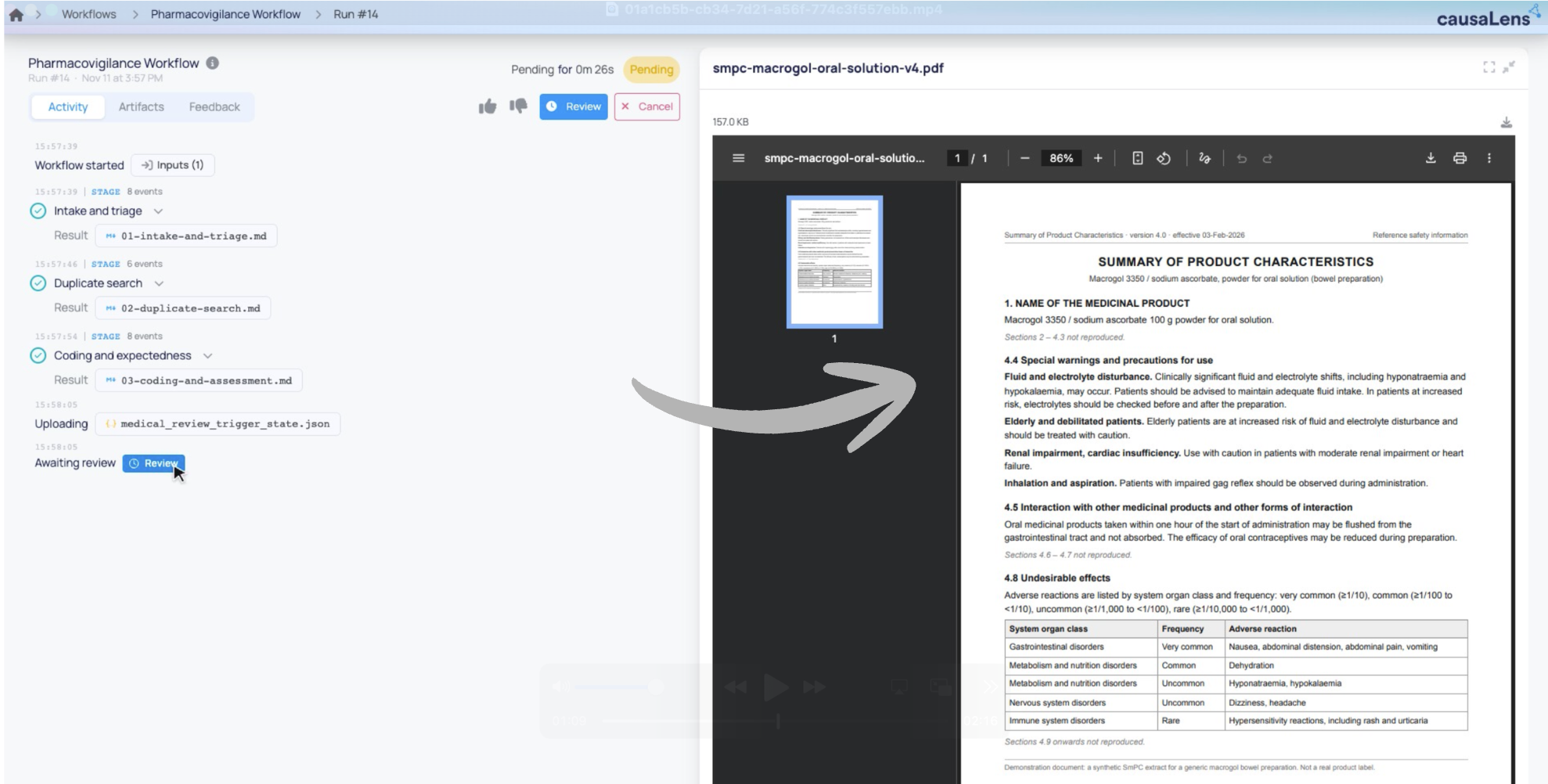
- When a case needs a medical call, the Worker sends one review: days left on the clock, proposed seriousness, what it coded, what it couldn't, and any concomitant drugs. The physician confirms, adds an instruction or sets a standing rule, and the decision is recorded under their name.
- While a case waits for review, the Worker moves on to the next one. The queue never stalls on a single question.
Built on the core capabilities of the causaLens Digital Worker platform
Behind the Pharmacovigilance Digital Worker is a team of agents - intake, duplicate search, coding, signal and submission - running on the same governed platform as every causaLens Digital Worker. That platform is why a safety team can hand it a live queue of regulatory deadlines.
Core Architecture:
- Copilots suggest. Brittle automation breaks. Digital Workers keep running.
- The Worker writes its automation as code. When a step fails - a safety database screen changes, a literature alert arrives in a new format, a regulator gateway updates - it diagnoses the failure, repairs the script and carries on with the queue. The fix is kept for every case after.
- Nothing medical moves without a person: seriousness, causality and ambiguous coding all pass through a review gate. Guardrails stop any agent that drifts, every proposal links back to the report and label text behind it, and every action lands in the audit trail.
Integrations:
- Safety databases - Oracle Argus and others - for case intake, processing and submission
- Shared safety mailboxes and the medical information call centre
- Literature screening and alert services
- Product labels and SmPCs for expectedness assessment
- MedDRA for event coding
- Regulator gateways - EudraVigilance (EMA) and the MHRA - for E2B transmission and acknowledgements
- Email, calendar and chat - Teams, Outlook and equivalents - for reviews and approvals
What It Replaces & Reduces:
- First-in, first-out triage that leaves serious cases waiting behind non-serious ones
- Follow-ups logged as new cases, on a clock that started weeks earlier
- Manual duplicate searches across channels and case records
- Hours of case processing before a physician sees anything worth a medical call
- Signals missed because no one had time to look across cases
- Days spent assembling compliance figures and audit evidence for inspections
Common questions, answered
No. Seriousness, causality and any ambiguous coding are always decided by your safety physician, and each decision is signed against their name. The Worker prepares the case and the evidence; the medical judgement stays with your team. That review gate is built into the platform and cannot be switched off.
Safety databases store and route cases; people still do the reading, duplicate searching and coding. This Worker does that work end to end, links follow-ups to their original case so the clock is right, and stops only where a medical call is needed - with the evidence already gathered.
The Worker searches the safety database before creating anything. If the report matches an existing case, it is linked as a follow-up and re-clocked from the original Day 0, so a case that looked like it had weeks left is worked as the urgent case it is.
The Worker looks across cases for patterns the label doesn't describe, such as a shared concomitant drug, and checks the published literature. When the evidence points the same way, it raises a signal with the case series and sources attached for your safety team to take forward.
Yes. For any case you can see the report it came from, what the Worker proposed, what your physician decided, what was submitted to each regulator and when it was acknowledged. Compliance figures in the safety report link back to individual cases and submissions, so your QPPV can stand behind them.
Yes. Products, affiliates, intake channels and regulator gateways are added to the query layer, not hard-wired into the workflow, so the Worker scales with your portfolio and markets.
Yes. We deploy on causaLens cloud, your private cloud, or fully on-premise. The Worker is model-agnostic - use our default model, or bring your own approved LLM. Your safety and patient data never leaves your environment unless you choose otherwise.
The Worker needs the same access a person running the process has today: your safety mailbox, safety database and regulator gateways, granted through your own credentials and permissions.
Typical timeline: an MVP in two to three weeks against a small, high-value scope, followed by a production deployment scoped to your data, security, validation and integration requirements. A dedicated causaLens AI engineer builds and runs the Worker; a causaLens value engineer owns project success.
It fits right in. Digital Workers run on the systems, data and approved LLM you already have, so there's no new platform to license, integrate and maintain. IT keeps full control over where the Worker is deployed and how it's governed.
Read more: Anti-Platform: The Software Industrial Complex Is Over and Why IT Teams Love causaLens
Production-grade, not prototype
Versus the manual, case-by-case workflow
Every safety team processes its cases. What gets squeezed is the work around them: reading the inbox in order of risk, catching the follow-up that arrived on a clock already running, and looking across cases for a pattern. That is where deadlines are missed and signals sit unnoticed. The Worker takes that work on at any volume, so your team spends its time on medical judgement and on-time performance no longer depends on how many people you have.
Versus outsourced case processing
Outsourcing moves the volume, not the problem. Cases still queue, follow-ups still get logged as new, and every query goes back and forth across another organisation. This Worker runs inside your own systems, keeps every medical call with your physician, and gives you the audit trail directly.
Versus generic LLM tools
A general-purpose model has no business calculating a regulatory clock or filing with a regulator. This Worker holds case data in structured, traceable records, tests its own output, leaves every medical call to a named person and logs each step from inbox to acknowledgement.