
Every rebate invoice checked to the claim - before anything is paid.
The Gross-to-Net Digital Worker takes the quarter's rebate invoices off hold and validates every line, and every claim behind it, against your product master, government pricing and accrual model. It prepares the disputes, payments and close pack across the systems your team already uses - while your GTN Lead keeps every judgement call.
Customers automating their workflows













Gross-to-net is where margin quietly leaks
Hundreds of invoices, one close period
Every close period brings a wave of rebate invoices - state Medicaid, managed care, PBM, Part D - each carrying thousands of NDC lines, all due inside a fixed window. Teams cannot review everything, so they triage by size and due date and hope the rest is right, even though experience tells them customers will have made mistakes and overpayments will happen.
Invoice-level checks miss claim-level errors
Standard validation - NDC, units per package, URA, trend thresholds - catches the obvious outliers. Errors that sit inside the review threshold, such as a dropped decimal on a liquid quantity, pass straight through and get paid. And once it’s paid, clawing back an overpayment takes a lot of work.
Paying a wrong invoice moves a right accrual
When an overbilled invoice is paid and trued-up, a correct accrual estimate is moved to match an incorrect number. With the work split across the ERP, spreadsheets and email, tracing any figure back to its claim takes days.
What Does This Digital Worker Do?
100% of invoices reviewed, in one trigger
- Hand the quarter's rebate invoices on hold to the Worker and trigger the autonomous workflow.
- The Worker navigates every system in the process - the ERP, the GTN accrual model, state claim files, pricing records and Teams - so each invoice is validated with full context, not just checked against a trend threshold.
Protects margin. At Scale.
- The Worker checks every claim behind every invoice line against package size, product master and government pricing, then corroborates anything unusual against a second source such as 3PL shipment data.
- What reaches the GTN Lead is a proposed dispute with its evidence attached and the accrual options already prepared.
Decide, dispute, close
- The GTN Lead decides the dispute and the accrual treatment, adds instructions, or makes a decision a standing rule.
- On approval the Worker files the disputes, releases the holds, schedules undisputed payments, updates the accrual model and compiles the close pack - with the true-up journal left for a separate approver.
- Every decision carries a full audit trail for external auditors.
blank space
Demo of the Digital Worker:
The invoice, the claims, the accrual and the decision - on one screen
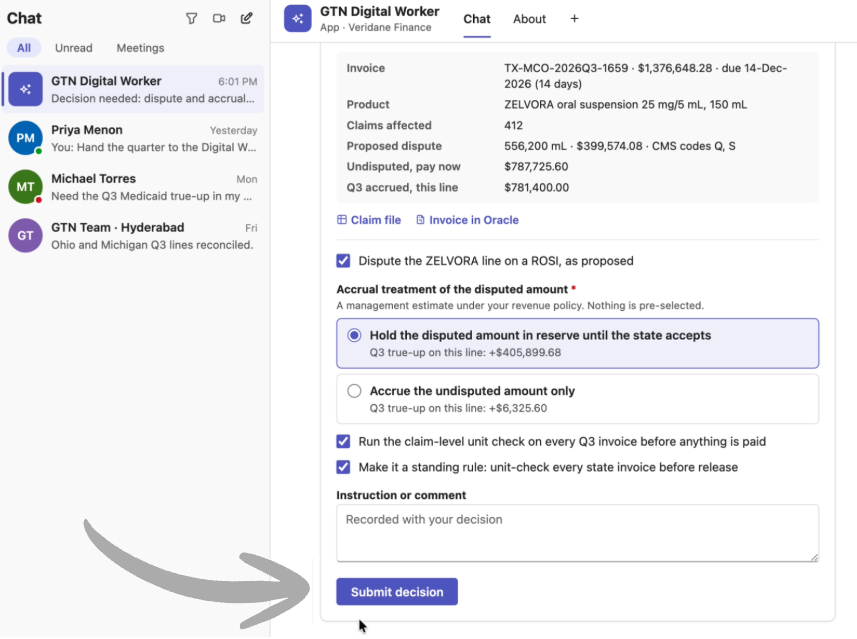
- The GTN Digital Worker is built for the GTN, government pricing and finance team, not for engineers.
- It sits across your ERP, your accrual model, state claim data and Microsoft Teams, validates every invoice end to end, and presents a proposed dispute and accrual options with the claim evidence that supports them - with the GTN Lead deciding before anything is disputed, paid or accrued.
- It doesn't get stuck waiting for human input: it raises the decision in Teams and keeps validating the rest of the quarter.
Built on the core capabilities of the causaLens Digital Worker platform
The GTN Digital Worker is a multi-agent system, governed end-to-end by the capabilities that underpin every causaLens Digital Worker. These are what make the difference between a spreadsheet check bolted onto the ERP and a Worker trusted with the rebate reserve.
Core Architecture:
- The capability that separates causaLens Digital Workers from copilots and brittle automation.
- Its self-healing loop writes the automation, runs it as code, and when that code errors - an ERP API change, a new claim file format, a moved column in the accrual model - the Worker inspects the failure and patches the script to keep the quarter moving, saving the fix for next time.
- Human-in-the-loop gates sit in front of every dispute, accrual treatment and journal, hard-stop guardrails halt agents that drift, every proposal comes with the claim lines and second-source evidence behind it, and every step is captured in a full audit trail.
Integrations:
- ERP and accounts payable - Oracle, SAP and others - for invoice holds, approvals and payments
- GTN accrual models in Excel or your planning system
- Email, calendar and chat - Teams, Outlook and equivalents - for decisions and approvals
- State claim-level data and rebate invoice files
- Product master, government pricing and URA records
- 3PL and shipment data for independent corroboration
- Dispute forms such as ROSI (CMS-304) and your general ledger for true-up journals
What It Replaces & Reduces:
- Triage-by-size reviews that leave most invoice lines unchecked
- Manual cross-checking of invoices against product master, pricing and trend
- Claim-level errors paid because they sat inside the review threshold
- Overpayments trued-up after the fact, moving accruals that were right
- The same root cause disputed state by state instead of once
- Days spent assembling the close pack and tracing figures for audit
- Lengthy, time-consuming disputes to recover overpaid monies
Common questions, answered
No. The Worker validates, investigates and proposes. The GTN Lead decides every dispute and accrual treatment, the decision is recorded against their name, and the true-up journal is approved by a separate person. The human-in-the-loop gate is part of the platform, not a setting.
Invoice-level validation checks NDCs, URAs and trend thresholds, then flags outliers for a person. This Worker goes beneath the invoice to every claim behind it, so errors that sit inside the review threshold are caught before payment - and each one comes with a proposed dispute, not just a flag.
It reaches the GTN Lead with the investigation already done - the claims identified, the error corroborated against a second source, the accrual reconciled and the dispute drafted. Where several errors share one root cause, the Worker surfaces it so the team can raise it once.
The blueprint starts with government rebate invoices, such as US state Medicaid, where claim-level errors are most costly. The same pattern extends to payer and PBM rebates, chargebacks and other GTN deductions, whichever jurisdictions you sell in, including the UK and EU. We scope coverage against your programmes and markets during the MVP.
Every step is captured in an audit trail: which invoices and claims were checked, against which sources, what was proposed, who decided, and what was filed, paid and posted. Every figure in the close pack traces to a claim, invoice or journal line, so the Worker can be relied on by controllers and external audit.
Yes. The Agentic Data Mesh is a query layer, not a point-to-point integration, so additional ledgers, entities, programmes or ERP instances can be added without re-writing the workflow.
Yes. We deploy on causaLens cloud, your private cloud, or fully on-premise. The Worker is model-agnostic - use our default model, or bring your own approved LLM. Your financial and claims data never leaves your environment unless you choose otherwise.
The Worker needs the same access a person running the process has today: your ERP, the accrual model and your claim and pricing data, granted through your own credentials and permissions.
Typical timeline: an MVP in two to three weeks against a small, high-value scope, followed by a production deployment scoped to your data, security and integration requirements. A dedicated causaLens AI engineer builds and runs the Worker; a causaLens value engineer owns project success.
It fits right in. Digital Workers run on the systems, data and approved LLM you already have, so there's no new platform to license, integrate and maintain. IT keeps full control over where the Worker is deployed and how it's governed.
Read more: Anti-Platform: The Software Industrial Complex Is Over and Why IT Teams Love causaLens
Production-grade, not prototype
Versus the manual, invoice-by-invoice workflow
Most GTN teams already validate invoices against trend thresholds. The hard part is everything beneath them: no team has the capacity to check every claim behind every line. So mistakes slip through and revenue is lost. The Worker does that at volume and hands the GTN Lead a decision instead of a research task. Coverage stops being a function of headcount.
Versus rules-based validation and RPA
Rules clear the lines that sit inside the threshold - which is exactly where errors such as a dropped decimal hide. Rules cannot compare a claim quantity to a package size, corroborate it against shipment data or reconcile it to the accrual. This Worker is built to solve exactly that gap.
Versus generic LLM tools
A generic model cannot be trusted to read hundreds of thousands of claim lines, interpret revenue policy and move a reserve. This Worker keeps financial data in typed, auditable structures, QAs its own findings, never disputes, pays or posts without a person deciding, and keeps a full audit trail end to end.