
Every new hire, day-one ready - without chasing a single ticket.
The Employee Onboarding Digital Worker runs the whole hire from offer-accepted to day-one ready - enriching the employee profile, drafting the contract, provisioning accounts, and creating, routing and chasing every onboarding ticket across IT, Facilities and HR. It works from inside the tool your team already uses, with a human approving everything that goes out.
Customers automating their workflows













Onboarding breaks in three predictable ways
Fragmented workflows across too many tools
HR managers and people-operations teams are stuck juggling multiple systems - Workday, Jira, Slack and several spreadsheets - just to get one new hire ready. Every hire means discrete tasks opened, routed, chased and closed across IT, Facilities, Legal, Payroll and HR, with no single place that shows the whole picture.
Manual follow-up on overdue tasks
Coordinators rely on tribal knowledge to know which template applies, which team owns which provisioning step, and which breach matters today. Overdue tasks like hardware provisioning are chased by hand. The result is inconsistent outcomes between coordinators, and signals - a missing PII field, a contract-clause gap, a hardware ticket about to breach - are easily missed with no systematic way to verify them.
Risk and inconsistency - a new hire without equipment on day one
Capacity caps how many tickets can be actively monitored, so the rest accumulate as silent breaches. That is exactly why a meaningful share of new hires start without a working laptop, the right access, or a signed contract - a missed ticket becomes a bad first day.
What Does This Digital Worker Do:
Automates cross-system runs
What takes a coordinator days of cross-system clicking is compressed into a single agent run, with human gates only where judgment is required. The candidate, the manager and the downstream teams get the right artifact in the right place on the same day the hire is triggered.
Handles hiring volume
One coordinator can supervise a far larger book of hires because the Digital Worker absorbs the mechanical work: ticket creation, template selection, account provisioning and status chasing. No staffing up People Ops to handle volume, and no point-solution per subsystem.
Checks every exception
Because the Worker checks every ticket at every checkpoint, nothing slips silently. Exceptions are surfaced with full context, so coordinators spend their time on decisions, not discovery.
Demo of the Digital Worker:
Trigger it from inside Workday. It runs the rest in the background.
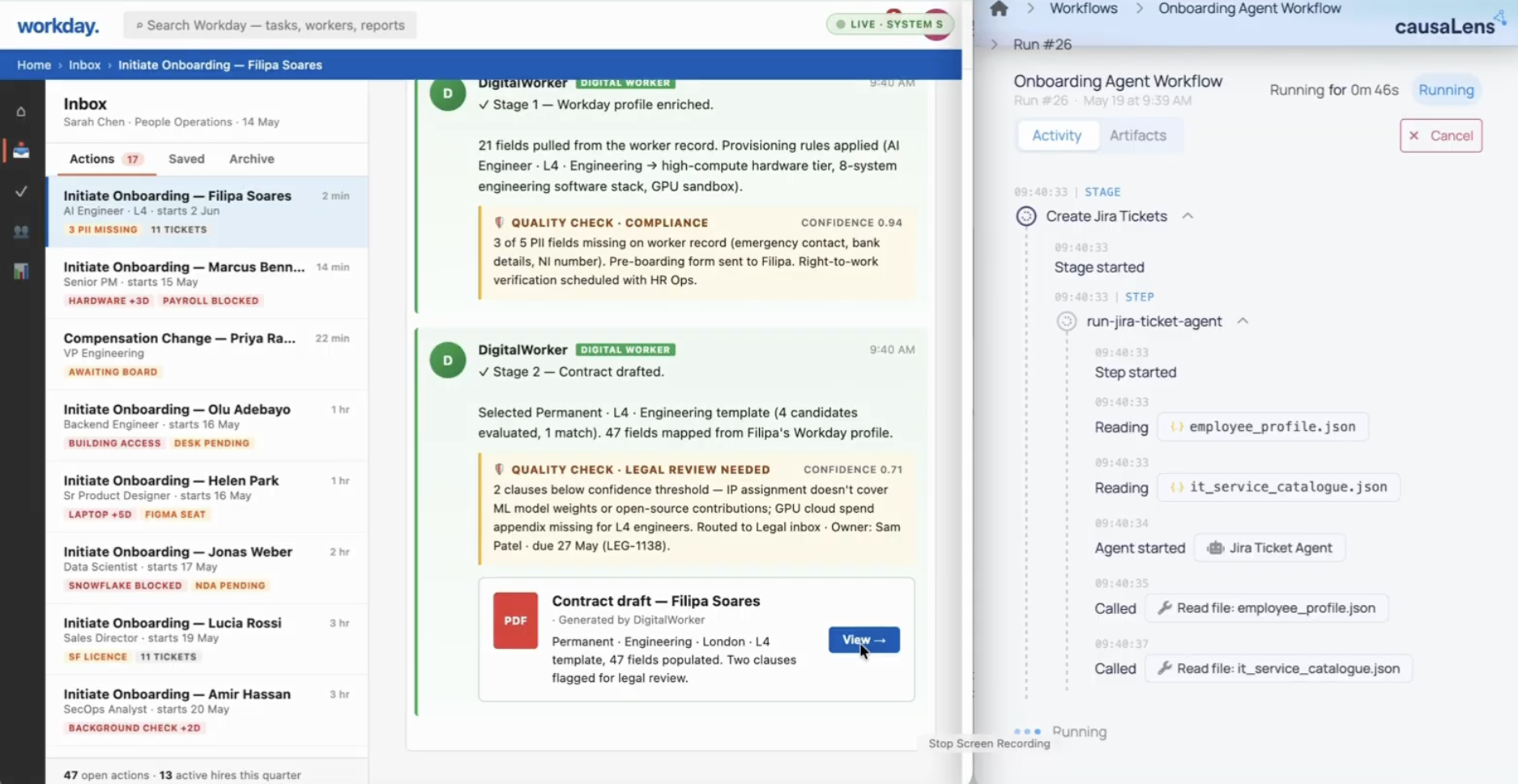
- The Employee Onboarding Digital Worker sits inside the systems the team already uses and behaves like a new kind of colleague - one that can be triggered from Workday and @-mentioned in the process comments.
- The HR manager stays in the tool they already know and simply starts the standard onboarding workflow; from there the Worker gets to work behind the scenes.
Works across the systems your onboarding already runs on
Illustrative coverage:
- Workday HCM (and equivalent HRIS) - the trigger point and employee system of record
- Jira ITSM (and equivalent ticketing) - onboarding ticket creation and routing
- Slack / Microsoft Teams - notifications, approvals and @-mention invocation
- IAM providers - account and access provisioning
- Your contract template store - contract drafting
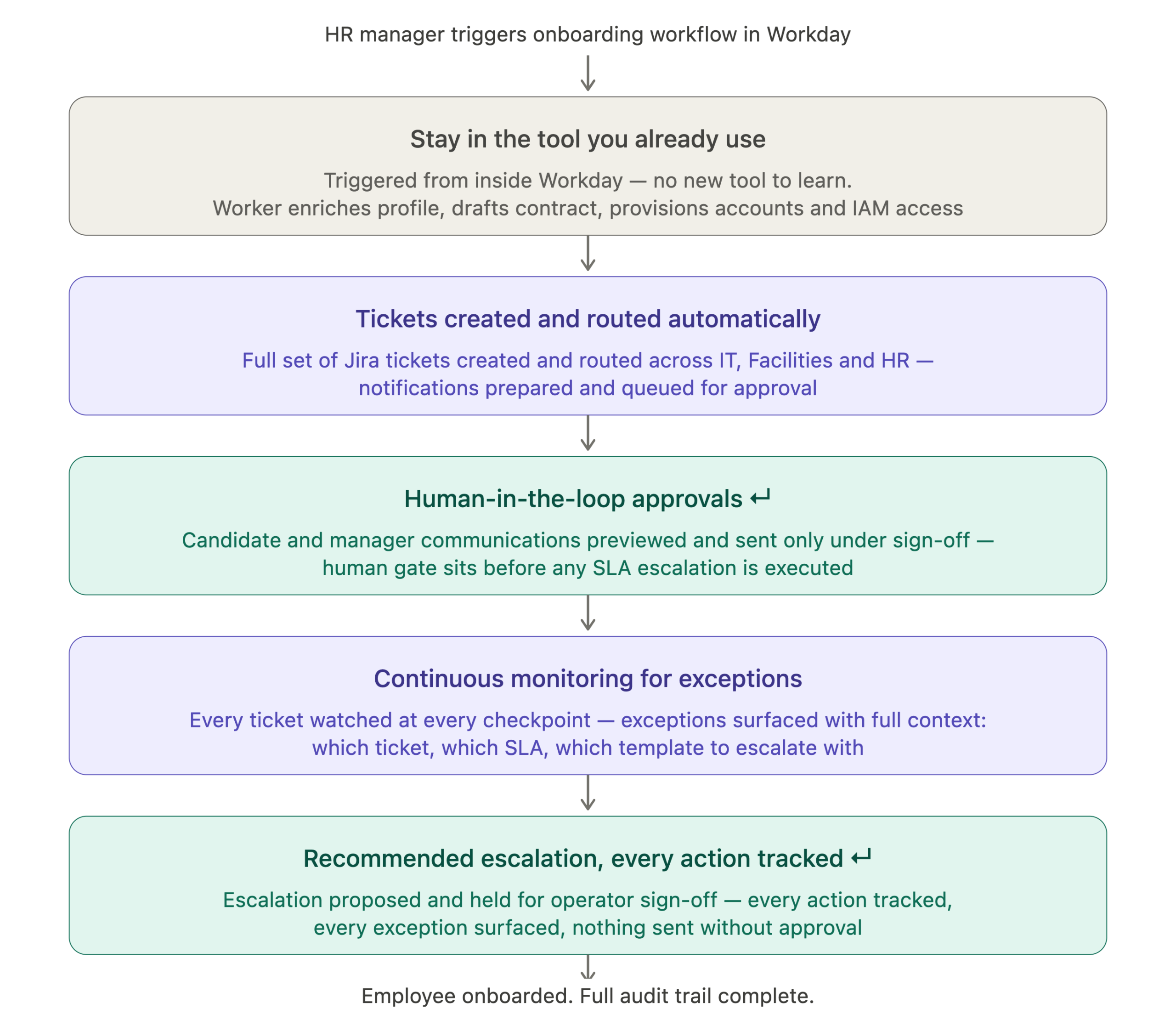
Built for the teams that get new hires day-one ready
- People Ops and HR coordinators - running hires from offer-accepted to day-one ready across four or more systems.
- HRIS and HR operations leaders - who want consistent, auditable onboarding at volume without growing the team linearly.
- IT service management and Facilities - the downstream teams that own provisioning and equipment tickets.
- Hiring managers - who need their new hire productive and equipped on day one.
- Shared services and HR BPO providers - delivering onboarding across business units or clients.
Built on the core capabilities of the causaLens Digital Worker platform
The Employee Onboarding Digital Worker is a multi-agent system, governed end-to-end by the capabilities that underpin every causaLens Digital Worker - the difference between a chat interface and an automation you can trust to run a hire across four systems unsupervised between gates.
The Multi-Agent Workflow:
A dynamic query layer over Workday HCM, Jira ITSM, Slack, the IAM providers and the contract template store. The Worker reasons over employee, ticket and access data in a uniform way - and the same agent can be redeployed into a new organisation with different underlying systems without re-writing the workflow.
Integrations:
- Workday HCM, Jira ITSM, Slack / Teams, IAM providers and your contract template store (see Section 5)
- Your approved large language model - we are model-agnostic and bring-your-own-LLM
- Deployment on causaLens cloud, your private cloud, or fully on-premise
What It Replaces & Reduces:
- Days of cross-system clicking to open, route and chase onboarding tickets
- Manual follow-up on overdue provisioning tasks like hardware
- Inconsistent, coordinator-dependent template selection and routing
- Silent SLA breaches that leave a new hire without equipment or access on day one
Common questions, answered
Typically Workday HCM, Jira ITSM, Slack or Teams, your IAM providers and your contract template store. Because it works through the Agentic Data Mesh, the same workflow can be redeployed onto a different HCM, ticketing tool or IAM provider without a rewrite.
No. The HR manager stays inside Workday - the tool they already use - and simply triggers the standard onboarding workflow. The Worker can also be @-mentioned in the process comments, so it behaves like a colleague rather than a new platform.
No. Candidate and manager communications are previewed and sent only under human approval, and a human gate sits before any SLA escalation is executed. Nothing is sent without sign-off - every action is tracked and every exception is surfaced for review.
It checks every ticket at every checkpoint, rather than sampling. When something is overdue or about to breach, it surfaces the exception with full context - which ticket, which SLA, which template to escalate with - and recommends the escalation for the operator to approve.
Yes. We deploy on causaLens cloud, your private cloud, or fully on-premise. The Worker is model-agnostic, so you can bring your own approved LLM, and your data never leaves your environment unless you choose otherwise.
Reliability is the core of the platform: human-in-the-loop gates before anything is sent or escalated, schema-validated artifacts acting as in-loop judges at every stage, and full provenance tracking. On benchmark workloads, key metrics without the Reliability Framework sat under 20%; with it applied, all move north of 80%, with precision and accuracy over 90%.
Not for onboarding specifically - this is a newer blueprint, and we are taking a small number of design partners. The platform it runs on is in production across regulated finance and commercial operations, governed by the same Reliability Framework.
People Ops and HR coordinators, with HRIS / HR operations leaders supervising. No engineering background is required - the team triggers the Worker from Workday and reviews the gates it raises.
Production-grade, not prototype
Versus manual coordination
Days of cross-system clicking become a single supervised run. Every ticket is created, routed and chased automatically, every exception is surfaced with context, and the candidate, manager and downstream teams get the right artifact in the right place on the same day.
Versus generic LLM tools
Generic LLMs drop fields, hallucinate values and keep no audit trail - unacceptable when a wrong access grant or a missed contract clause is the result. This Worker handles every structured field through traceable tools, gates everything outbound behind human approval, and is governed end-to-end by the Reliability Framework.
Versus HCM and ITSM point tools
Your HCM and ticketing systems each hold a slice of onboarding; they do not run the cross-system workflow, chase the overdue tickets, provision the access and escalate the breaches. This Worker coordinates across all of them and closes the loop, rather than adding another console to check.
The Reliability Framework
Human-in-the-loop gates before anything is sent or escalated, schema-validated artifacts at every stage, and full provenance tracking. This is the layer that lets a long-running agent run a hire across four systems between gates - controlled, auditable and safe to trust.