
From statement of work to active contract - in days, not weeks.
The Procurement Digital Worker runs the SOW-to-PO lifecycle end to end across the systems your team already uses - validating the statement of work, drafting the contract, routing approvals and chasing the requisition - while your team keeps sign-off on the contracts that matter.
Customers automating their workflows













Procurement is a tangle of approvals coordinated by email
Every organisation's process is different - and grown organically
The procurement process in a large organisation is a web of approvals and checks that has accrued over years as the company has grown. A one-size-fits-all tool does not acknowledge the diversity of business models and their specific controls - which is exactly why generic automation tends to fail here.
Manual cross-checking across fragmented systems
A typical flow starts with a ServiceNow ticket and an attached statement of work. The procurement team cross-checks it against prior SOWs for that supplier, confirms it is covered by the project budget, and reviews the document for completeness. A contract shell then has to be created in Salesforce and a requisition raised in the procurement system - each in a different tool, each requiring its own context.
Coordinated by email, measured in weeks
The whole process is stitched together by email and waits on a chain of business approvers. Even a simple requisition from an approved supplier can take weeks to clear - not because any single step is hard, but because the coordination across systems and people is slow and sequential.
What Does This Digital Worker Do:
Automates the process end-to-end
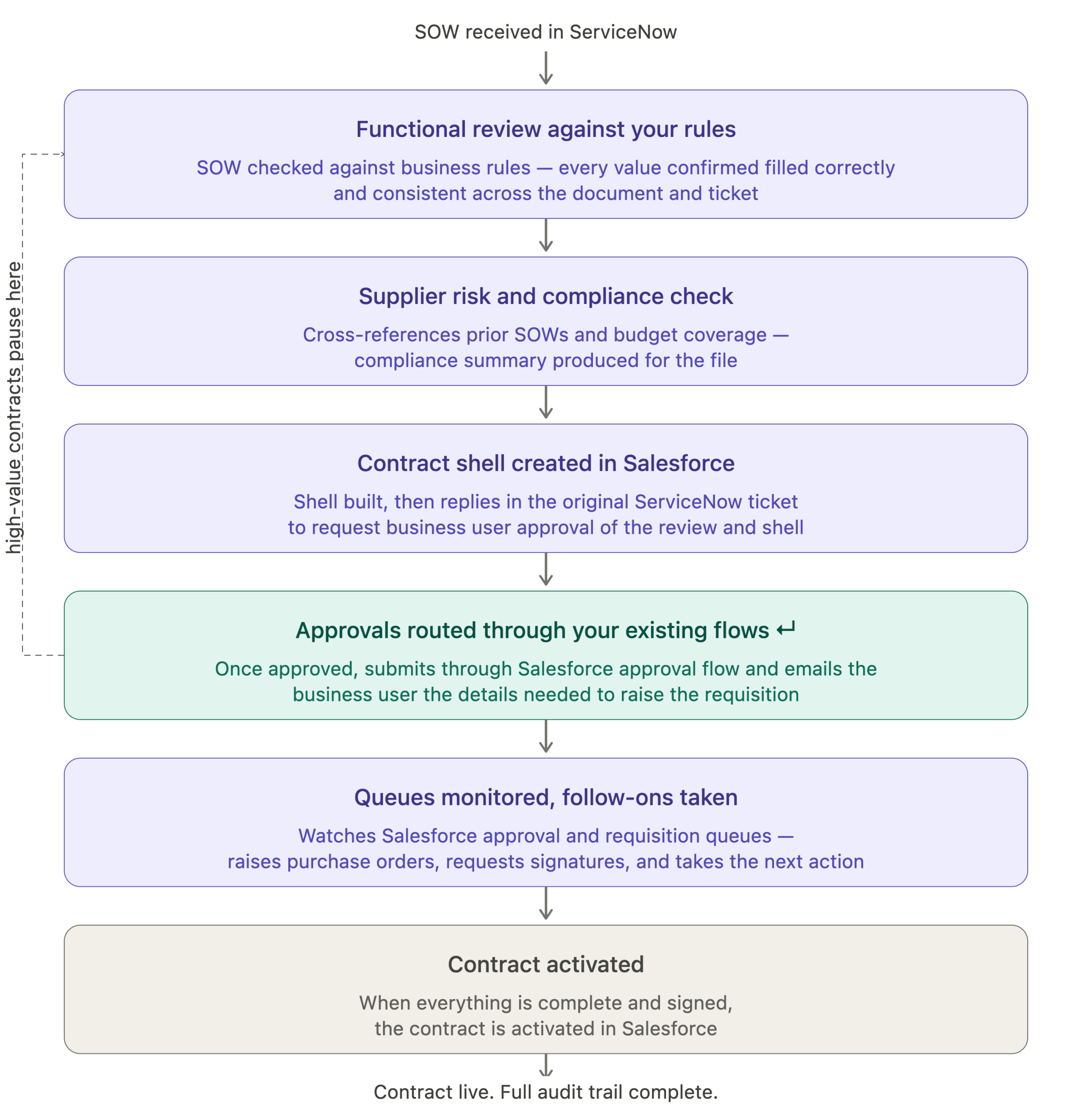
A process that runs in weeks compresses to days. The Worker does the functional review, drafts the contract, routes approvals and chases the requisition without anyone re-keying between systems.
Reduces OPEX. At Scale.
A large procurement team's mechanical work is absorbed, and brittle RPA is retired. Instead of a standing team maintaining bots that break on every change, an agentic Digital Worker is the upgrade - not another bot to babysit.
Consistency follows the right process
Every SOW is validated against the same business rules, every contract shell is built the same way, and nothing stalls unnoticed in an inbox.
Demo of the Digital Worker:
Assign the ticket. The Digital Worker runs the rest.
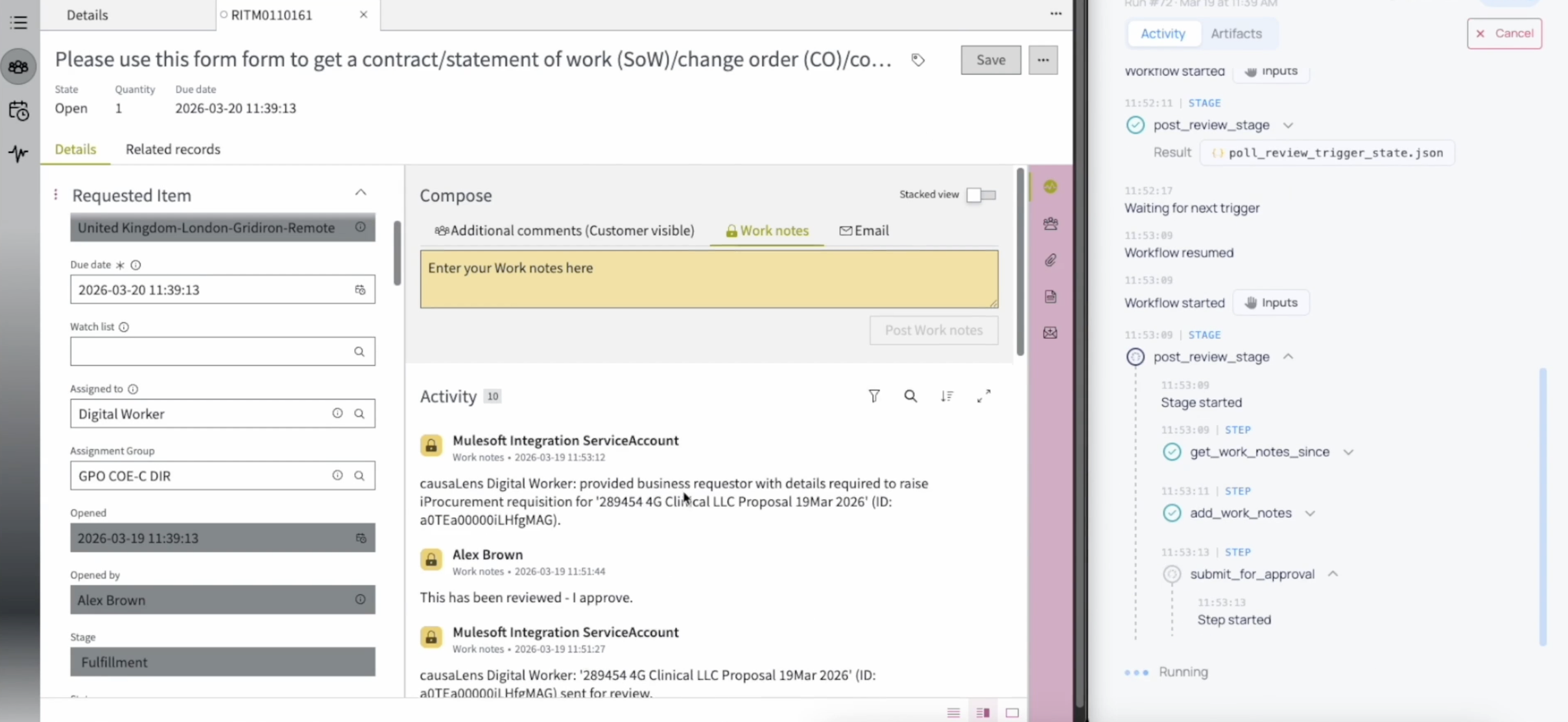
- The Procurement Digital Worker works directly in the systems the procurement team already uses - it is not another platform to learn.
- The team assigns the ServiceNow ticket to the Worker, and behind the scenes it handles the lifecycle:
Works inside the procurement stack you already run
Illustrative coverage:
- ServiceNow - intake ticket and the team's coordination surface
- Salesforce - contract shell, approval flow and activation
- Oracle iProcurement (and equivalent P2P / requisition systems)
- Adobe e-signature / Acrobat Sign for signatures
- Email for business-user coordination and approvals
Built for the teams that move contracts through the business
- Procurement and sourcing operations - processing SOWs and requisitions from approved suppliers at volume.
- Vendor and supplier management - keeping checks and budget coverage consistent across every contract.
- Finance and accounts payable - who depend on clean, correctly-raised purchase orders and requisitions.
- Shared services and BPO providers - running procurement operations across business units or clients.
- Regulated and high-volume industries - CROs, life sciences and others where SOW volume is high and contracts are largely standardised.
Built on the core capabilities of the causaLens Digital Worker platform
The Procurement Digital Worker is a multi-agent system, governed end-to-end by the capabilities that underpin every causaLens Digital Worker - the difference between a brittle bot and an automation you can trust with $350k contracts.
The Multi-Agent Workflow:
The capability that separates causaLens Digital Workers from copilots and RPA. Human-in-the-loop checkpoints are used extensively, because many steps need a human to verify the details on contracts worth up to $350k. In-loop LLM judges act as quality gates on the SOW review, verifying findings are accurate and grounded in the actual document and ticket. And the self-healing loop keeps the automation working when an underlying system changes - the agent patches the script rather than the whole flow breaking.
Integrations:
- ServiceNow, Salesforce, Oracle iProcurement, Adobe e-signature and email
- Your existing approval flows, reused rather than replaced
- Your approved large language model - we are model-agnostic and bring-your-own-LLM
- Deployment on causaLens cloud, your private cloud, or fully on-premise
What It Replaces & Reduces:
- Weeks of email-coordinated approvals for routine requisitions
- Manual cross-checking of SOWs against prior contracts and budget
- Brittle RPA bots that break on every system change and need a team to maintain
- Re-keying the same data across ServiceNow, Salesforce and the requisition system
Common questions, answered
Out of the box: ServiceNow, Salesforce, Oracle iProcurement, Adobe e-signature and email. Because it works through the Agentic Data Mesh, the workflow plugs into your existing procurement stack rather than being tied to these specific tools - so it adapts to your systems without a rewrite.
RPA bots follow brittle, screen-level scripts that break on any change and need a team to maintain. This Worker reasons about the SOW and the process, gates high-value contracts with human review, and uses a self-healing loop to adapt when an underlying system changes - so it keeps working instead of breaking.
No. Human-in-the-loop checkpoints are used extensively, because many steps require a person to verify details on contracts worth up to $350k and beyond. The Worker prepares, validates and routes; your business approvers retain sign-off.
Not always. Where SOWs are largely standardised, engagements have gone straight to implementation. Where the process is more bespoke, we scope a short MVP against a priority slice first.
Yes. We deploy on causaLens cloud, your private cloud, or fully on-premise / air-gapped. The Worker is model-agnostic - use our default model or bring your own approved LLM. Your data never leaves your environment unless you choose otherwise.
Reliability is the core of the platform: human-in-the-loop gates on high-value steps, in-loop LLM judges on the SOW review, the self-healing loop and full provenance. On benchmark workloads, key metrics without the Reliability Framework sat under 20%; with it applied, all move north of 80%, with precision and accuracy over 90%.
Procurement and sourcing operations, vendor management and the finance/AP teams downstream. No engineering background is required - the team simply assigns the ticket to the Worker in ServiceNow as they would to a colleague.
Production-grade, not prototype
Versus manual coordination
Weeks become days. The functional review, contract shell, approval routing and requisition chasing happen without anyone re-keying between systems - and high-value contracts still get human sign-off.
Versus RPA (UiPath and similar)
Rule-based bots are brittle: they break the moment a screen or field changes, and they need a standing team to maintain. The self-healing loop lets this Worker adapt to underlying system changes automatically, and it reasons about the SOW rather than just clicking through it. Where an organisation has been running a costly RPA estate that a team has to keep alive, the agentic approach is the upgrade.
Versus generic LLM tools
Generic LLMs have no audit trail and no protection against a mis-copied contract value. This Worker handles every structured field through traceable tools, gates high-value steps with human review, and is governed end-to-end by the Reliability Framework.
The Reliability Framework
Human-in-the-loop checkpoints, in-loop LLM judges on the SOW review, the self-healing loop and full provenance. This is the layer that lets a long-running agent handle contracts worth hundreds of thousands of dollars - and stay reliable as your systems change.